Introduction #
As AI applications become more powerful, they need to interact with external tools and services such as GitHub, Slack, Google Drive, databases, CRMs, and APIs. However, integrating each service separately creates unnecessary complexity.
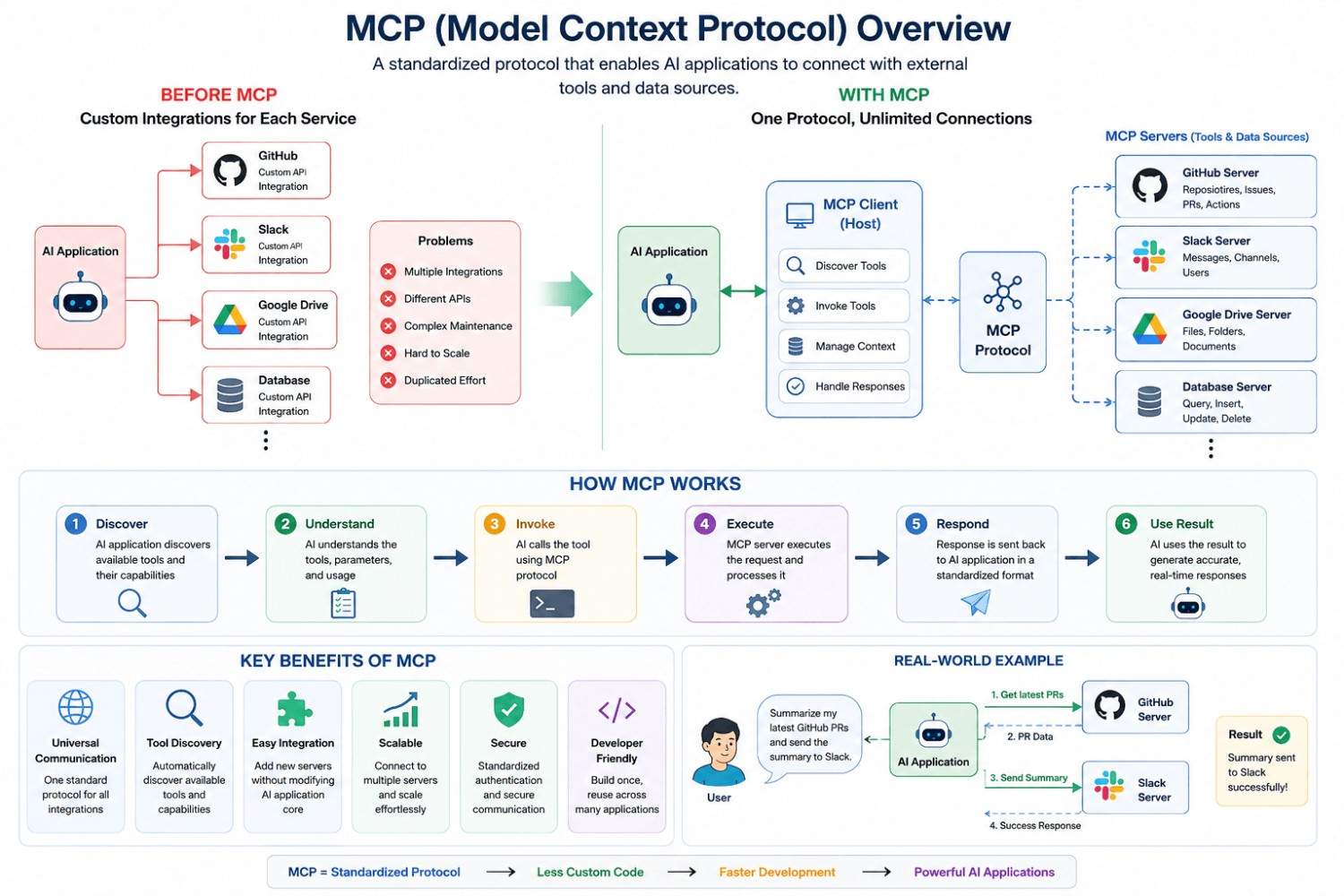
To solve this problem, Anthropic introduced the Model Context Protocol (MCP)—an open standard that allows AI applications to communicate with external tools using a single, standardized protocol.
Think of MCP as the USB-C of AI integrations: instead of building a different connector for every tool, applications use one common standard that works across many services.
What is MCP? #
Model Context Protocol (MCP) is an open communication protocol developed by Anthropic that standardizes how AI applications (called hosts) communicate with external tools, data sources, and services (called servers).
It provides a universal interface that enables Large Language Models (LLMs) to:
- Access external data
- Execute tools
- Perform actions on third-party services
- Retrieve real-time information
- Extend their capabilities beyond their training data
Instead of relying only on what the model already knows, MCP allows AI systems to interact with live systems securely and consistently.
Official Definition #
Model Context Protocol (MCP) is an open, standardized communication protocol that enables AI applications and Large Language Models (LLMs) to seamlessly connect with external servers, tools, and data sources, allowing them to retrieve information, execute actions, and enhance their capabilities beyond their training data.
Why Was MCP Created? #
Before MCP, every AI application had to build custom integrations for every external service.
For example:
- ChatGPT → GitHub Integration
- ChatGPT → Slack Integration
- Claude → Google Drive Integration
- Claude → Database Integration
Each integration required:
- Different APIs
- Different authentication methods
- Different implementation logic
- Different maintenance
This resulted in duplicated work, inconsistent architectures, and difficult maintenance.
MCP solves this problem by introducing one universal communication standard.
Problems Before MCP #
Without MCP:
- Every AI application needed separate integrations.
- Developers repeatedly wrote similar connector code.
- Different tools exposed different interfaces.
- Scaling to dozens of services became difficult.
- Maintenance costs increased significantly.
As the number of integrations grew, development became increasingly complex.
How MCP Solves These Problems #
MCP provides a common protocol that every AI application and tool can understand.
Instead of learning a new integration for every service, AI applications communicate through the same standardized interface.
This makes integrations:
- Faster to build
- Easier to maintain
- More secure
- Highly scalable
- Reusable across different AI applications
Key Benefits of MCP #
1. Universal Language for AI-to-Tool Communication #
MCP provides a common communication standard that works across multiple tools and services.
Instead of custom APIs for every integration, applications use one consistent protocol.
2. Standardized Tool Discovery #
AI applications can automatically discover:
- Available tools
- Supported capabilities
- Input parameters
- Expected outputs
No custom implementation is required for each service.
3. Standardized Tool Invocation #
Once tools are discovered, AI models can invoke them using a consistent request format.
Whether calling GitHub, Slack, Google Drive, or a database, the interaction follows the same protocol.
4. Scalable Architecture #
Developers can add new MCP servers without modifying the AI application’s core logic.
This allows AI systems to grow by simply connecting additional servers.
5. Better Developer Experience #
With MCP, developers write integrations once and reuse them across multiple AI applications.
This reduces development time and maintenance effort.
Real-World Example #
Imagine you ask an AI assistant:
“Summarise my latest GitHub pull requests and send the summary to Slack.”
Without MCP:
- Custom GitHub integration
- Custom Slack integration
- Separate authentication
- Separate API implementations
With MCP:
- The AI discovers the GitHub server.
- It retrieves the latest pull requests.
- It generates a summary.
- It discovers the Slack server.
- It posts the summary to the desired channel.
All of these interactions use the same standardized protocol.
Common Services That Can Use MCP #
MCP can connect AI applications to many external systems, including:
- GitHub
- Slack
- Google Drive
- Google Calendar
- Gmail
- Notion
- Databases (PostgreSQL, MySQL, MongoDB)
- Local file systems
- REST APIs
- Cloud storage
- Enterprise applications
- Custom internal tools
Why MCP Matters #
Modern AI applications are no longer expected to only answer questions.
Users expect them to:
- Read documents
- Search databases
- Access cloud storage
- Send emails
- Create calendar events
- Manage repositories
- Automate workflows
MCP provides the standardized foundation that makes these capabilities possible across different platforms.
Summary #
Model Context Protocol (MCP) is rapidly becoming one of the most important standards for AI integration.
By providing a universal communication protocol between AI applications and external tools, MCP eliminates the need for custom integrations and enables scalable, secure, and reusable AI workflows.
As more tools adopt MCP, developers will be able to build richer AI applications with significantly less integration effort.
MCP Quiz #
Q.1 What is Model Context Protocol (MCP)?
A programming language for building AI models.
An open protocol that standardizes communication between AI applications and external tools.
A cloud platform for hosting AI models.
A database management system.
Explanation
Model Context Protocol (MCP) is an open protocol developed by Anthropic that standardizes how AI applications communicate with external tools, services, and data sources.
Q.2 Why was MCP created?
To replace Large Language Models.
To increase AI model training speed.
To provide a standardized way for AI applications to integrate with external tools.
To reduce internet bandwidth usage.
Explanation
Before MCP, every AI application required separate integrations for each external service. MCP solves this by providing one standardized communication protocol.
Q.3 Which company developed the Model Context Protocol (MCP)?
Google
Microsoft
OpenAI
Anthropic
Explanation
Model Context Protocol (MCP) was introduced by Anthropic as an open standard for AI-to-tool communication.
Q.4 Which of the following is NOT a typical service that MCP can connect to?
GitHub
Slack
Google Drive
Microsoft Paint
Explanation
MCP commonly connects AI applications to services like GitHub, Slack, Google Drive, databases, APIs, and other external tools. Microsoft Paint is not a typical MCP server.
Q.5 In the context of Model Context Protocol (MCP), what is the primary role of the Host?
Managing the low-level communication protocol for each individual server.
Converting JSON-RPC messages into HTTP requests for remote access.
Acting as the AI chatbot interface that interacts with the user.
Providing the actual tool execution environment, like a GitHub API.
Explanation
The MCP Host is the AI application (such as Claude Desktop, ChatGPT, or Cursor) that interacts directly with the user and coordinates communication with MCP Clients.
Q.6 Which communication protocol is commonly used by MCP?
SOAP
GraphQL
JSON-RPC 2.0
FTP
Explanation
MCP commonly uses JSON-RPC 2.0 as its standardized communication protocol between the MCP Client and MCP Server.
Q.7 Which transport mechanism is commonly used for communication with a local MCP Server?
SMTP
STDIO
Bluetooth
FTP
Explanation
STDIO (Standard Input/Output) is commonly used when an MCP Client communicates with a local MCP Server.
Q.8 What can an MCP Server expose to AI applications?
Only databases
Only APIs
Tools, Resources, and Prompts
Only programming languages
Explanation
An MCP Server can expose three primary capabilities: Tools, Resources, and Prompts.
Q.9 What is one major benefit of MCP?
It requires separate integrations for every application.
It eliminates the need for external APIs.
It provides a standardized and scalable way to connect AI applications with external tools.
It replaces all databases with AI models.
Explanation
MCP simplifies AI development by providing one standardized protocol for connecting AI applications with external tools and services.
Q.10 Which statement best describes MCP?
It is a machine learning algorithm.
It is a standardized communication protocol for AI applications and external tools.
It is a cloud database.
It is a web browser.
Explanation
Model Context Protocol (MCP) is an open, standardized communication protocol that enables AI applications to interact with external tools, data sources, and services.


