Welcome to The Ultimate Interview Preparation Guide (100 Questions & Answers)—a comprehensive resource designed to help you master LangGraph, Agentic AI, and modern AI application development.
This guide covers 100 carefully selected interview questions, progressing from beginner to architect level, with detailed explanations, real-world examples, production use cases, architecture diagrams, code snippets, and interview tips. Each question is crafted to strengthen your conceptual understanding while preparing you for technical interviews at both service-based companies (TCS, Infosys, Accenture, Cognizant, Capgemini, Wipro, HCL) and product-based companies (Google, Microsoft, Amazon, Meta, OpenAI, Anthropic, NVIDIA, Uber, LinkedIn, and others).
Whether you’re a student, job seeker, software engineer, or AI developer, this guide will help you build a strong foundation in LangGraph and Agentic AI while gaining the practical knowledge required to design, develop, and deploy production-ready AI systems.
Let’s begin your journey toward becoming interview-ready and mastering the future of AI engineering. 🚀
Difficulty Level Beginner 1-20 #
1. What is the fundamental difference between Generative AI and Agentic AI?
Answer: The core difference lies in behavior vs. capability. Generative AI is a capability used primarily for content creation (text, images, video) and is inherently reactive; it waits for a user prompt and provides a one-shot response. Agentic AI, conversely, is a behavioral paradigm where the system is proactive and goal-oriented. While a Generative AI system might write a single job description when asked, an Agentic system takes a high-level goal (e.g., “Hire a Backend Engineer”) and autonomously handles the planning, JD drafting, posting to job portals, resume screening, and interview scheduling. Generative AI acts as the “brain” within the larger Agentic system.
2. How would you define an AI Agent according to the “Agentic AI” framework?
Answer: An AI Agent is a system that can independently think, plan, and take actions to achieve a specific goal. Unlike standard software that follows a fixed, coded script, an agent uses a Large Language Model (LLM) as its reasoning engine to decide which steps to take and which tools to use. It moves away from “AI as a chatbot” to “AI as a coworker”. The agent operates in a loop: it receives a goal, creates an execution plan, performs actions via tools, observes the environment, and adapts its plan if it detects problems, such as a low number of applicants in a recruitment task.
3. Why is LangGraph preferred over standard LangChain for building complex agents?
Answer: While LangChain is excellent for building linear, directed acyclic graphs (DAGs) or simple chains, it struggles with cyclical logic (loops) and complex state management. Standard LangChain “chains” are primarily stateless, meaning they don’t natively remember what happened in previous steps without manual “glue code” to pass variables. LangGraph is an orchestration framework built on top of LangChain specifically designed to handle stateful, multi-step, and cyclical workflows. It treats a workflow as a directed graph where nodes are tasks and edges are the transitions, allowing an agent to loop back to a previous task (e.g., a “writer” node looping back to “research” if the info is insufficient).
4. What are the three core components of a LangGraph application?
Answer: The three fundamental pillars of LangGraph are:
- Nodes: These are the “workers” of the graph. In code, they are Python functions that receive the current state, perform a task (like an LLM call or tool execution), and return a partial update to the state.
- Edges: These define the control flow. Normal Edges create a fixed path between nodes, while Conditional Edges use a routing function to decide the next node at runtime based on the data in the state.
- State: This is a shared, mutable memory (usually a
TypedDict) that flows through every node. It acts as the “single source of truth,” allowing nodes to share information and track progress across the entire execution.
5. Explain the concept of “State” in LangGraph and why it is critical.
Answer: State is a collection of data points that the workflow requires to execute and evolve over time. It is implemented as a shared memory object that is accessible and modifiable by every node in the graph. It is critical because it solves the statelessness problem of traditional LLM calls. As a graph executes, the state “evolves”; for example, in a math workflow, Node 1 might set the initial numbers, and Node 2 updates the state with the calculated sum. Without this shared state, developers would have to manually pass every variable through every function, leading to “spaghetti code” in complex systems.
6. What are the 6 key characteristics of a true Agentic AI system?
Answer: According to the course materials, an agentic system must possess these six traits:
- Autonomy: The ability to act independently without step-by-step human instructions.
- Goal-Orientation: Operates with a persistent objective in mind.
- Planning: Can break a high-level mission into actionable sub-tasks.
- Reasoning: Uses logic to interpret information and make decisions.
- Adaptability: The capacity to identify failures and adjust its strategy mid-execution.
- Context-Awareness: Maintains memory of past interactions and understands the environment.
7. What is a “Node” in LangGraph, and what are its primary responsibilities?
Answer: A Node is a Python function that represents a single unit of work in a LangGraph graph. Its primary responsibility is to take the current State as input, process it (e.g., call an LLM to generate a blog outline), and return a dictionary containing partial updates to that state. Nodes are modular, making them easy to test individually. They can perform various roles, such as calling an LLM, searching a database, performing mathematical calculations, or acting as a routing gatekeeper.
8. Distinguish between Normal Edges and Conditional Edges in LangGraph.
Answer:
- Normal Edges: These are deterministic paths. If you add an edge from Node A to Node B, the graph will always move to Node B as soon as Node A finishes its execution.
- Conditional Edges: These provide dynamic routing logic, acting like “if-else” statements. They use a router function to evaluate the current state at runtime and return the name of the next node. For example, in a sentiment analysis bot, a conditional edge can route “positive” reviews to a “thank you” node and “negative” reviews to a “diagnosis” node.
9. What does it mean to “Compile” a graph in LangGraph?
Answer: Compilation is the process of converting a defined StateGraph (the blueprint of nodes and edges) into a Runnable object that can be executed. Compilation performs several critical tasks:
- Validation: It checks for structural errors, such as orphan nodes or missing START/END points.
- Infrastructure Injection: This is where you attach Checkpointers to enable persistence and memory.
- Optimization: It prepares the graph for execution using the Google Pregel model, which manages synchronization between nodes.
10. Explain the concept of “Persistence” and “Checkpointing” in LangGraph.
Answer: Persistence is the ability of an agent to save its state so it can survive crashes, server restarts, or human feedback pauses. Checkpointing is the mechanism that achieves this by taking a “snapshot” of the graph’s state after every super-step (the completion of a node’s execution). LangGraph uses a Checkpointer (like MemorySaver or SqliteSaver) to write these snapshots to a database. This allows for Fault Tolerance (resuming from the failure point) and Time Travel (viewing or replaying past states of the agent).
11. What are Reducers in LangGraph, and why do we use Annotated types?
Answer: By default, when a node returns an update for a state key, LangGraph overwrites the old value with the new one. Reducers are functions that define a different “merge policy”. We use the Python Annotated type to link a specific reducer to a state key. For example, using operator.add as a reducer on a “messages” list ensures that new messages are appended to the list rather than replacing the entire history. This is essential for maintaining chat history or aggregating results from parallel tasks.
12. What is a “Human-in-the-loop” (HITL) pattern?
Answer: HITL is a design pattern where an autonomous agent pauses its execution to seek human oversight, approval, or additional input before proceeding. This is vital for high-risk actions like making financial payments or posting to social media. In LangGraph, this is implemented using the interrupt() function and Checkpointers. The graph saves its state, pauses at a specific node, and waits for a human “Command” to resume, ensuring accountability and safety in production AI systems.
13. What is “Time Travel” in LangGraph, and how is it used for debugging?
Answer: Time Travel is a powerful debugging feature enabled by LangGraph’s persistent checkpointing. Since every state transition is saved in a database with a unique checkpoint_id, developers can:
- View History: Inspect what the agent was thinking at any previous step.
- Replay: Re-run the graph from a specific historical point to see if the outcome changes.
- Fork: Jump back to a past state, modify the state (e.g., change a topic from “Pizza” to “Samosa”), and start a new execution branch from that exact moment.
14. Explain the difference between Sequential and Parallel workflows.
Answer:
- Sequential Workflows: Tasks execute one after another in a linear chain (A -> B -> C). Each task depends on the output of the previous one.
- Parallel Workflows: Multiple independent nodes execute simultaneously (Fan-out), and their results are merged back into a single node (Fan-in). For example, analyzing an essay for “Grammar,” “Depth,” and “Clarity” can be done in parallel to reduce total latency. Parallel workflows require Reducers to safely merge updates to the same state key from different nodes.
15. What is an Iterative (looping) workflow?
Answer: Iterative Workflows involve cycles where the graph loops back to a previous node until a specific condition or quality threshold is met. A classic example is the Optimizer-Evaluator pattern: a “Generator” node creates a draft, an “Evaluator” node critiques it, and if the score is too low, a conditional edge loops the control back to the generator with feedback for a rewrite. To prevent infinite loops, these workflows usually include a max_iterations counter in the state.
16. How do you implement Short-Term and Long-Term memory in LangGraph?
Answer:
- Short-Term Memory: This is thread-specific and handled by Checkpointers (like SQLite). It maintains the context of a single ongoing conversation thread, allowing the agent to remember what was just discussed.
- Long-Term Memory: This spans across different threads and users. It involves using a Memory Store (often a Vector DB) to extract and store “memories” or preferences about a user (e.g., “User prefers Python examples”) and retrieving them via semantic search to personalize future interactions in completely new chat threads.
17. What are “Tools” in LangGraph, and how does the agent interact with them?
Answer: Tools are Python functions that grant an agent “hands and eyes” to interact with the real world, such as searching the web, performing math, or calling an API. The interaction follows a specific loop:
- The agent (LLM) decides a tool call is needed and returns a structured request.
- A specialized ToolNode executes the actual Python code.
- The tool’s raw result is returned to the agent, which summarizes or refines the info into a user-friendly answer.
18. What is the role of the “Brain” (LLM) in an agentic workflow?
Answer: The LLM serves as the central reasoning and decision-making engine. Its roles include:
- Goal Interpretation: Understanding the user’s intent.
- Planning: Creating a multi-step strategy to reach the goal.
- Tool Selection: Determining which tool is appropriate for a task.
- Reasoning & Observation: Analyzing results from tools or the environment to see if the goal is met or if a loop/adaptation is needed.
19. What is LangSmith and why is it essential for LangGraph observability?
Answer: LangSmith is an observability platform that provides an “X-ray view” of an agent’s execution. Because LangGraph involves non-linear loops and state changes, it is very hard to debug with just console logs. LangSmith captures every node execution, state update, and LLM call as a Trace. It allows developers to track latency, monitor token costs, and group multiple turns of a single conversation into a Thread view, making it easy to identify where a hallucination or tool failure occurred.
20. What is the Model Context Protocol (MCP) and why is it relevant to LangGraph?
Answer: MCP is an open standard that decouples AI agents from the data sources and tools they use. Traditionally, every tool integration (Slack, GitHub, SQL) required custom “glue code” for every new framework. MCP standardizes this interaction using a Client-Server architecture. A LangGraph MCP Client can connect to any compliant MCP Server to discover and execute tools automatically, making agent architectures highly modular, future-proof, and easy to scale without rewriting integration code.
LangGraph & Agentic AI: Questions 21–40 (Intermediate to Advanced) #
21. What is Corrective RAG (CRAG) and how does it solve the “Blind Trust” problem in traditional RAG?
Traditional RAG blindly trusts retrieved documents, even if they are irrelevant to the query, leading the LLM to generate incorrect or hallucinated answers based on poor context. Corrective RAG (CRAG) introduces a Retrieval Evaluator node between retrieval and generation. This evaluator scores retrieved documents as Correct, Incorrect, or Ambiguous.
- If Correct, it proceeds with knowledge refinement.
- If Incorrect, it discards the documents and triggers a Web Search (e.g., via Tavily) to find accurate information.
- If Ambiguous, it merges both internal documents and web results to form a comprehensive context.
22. Explain the “Knowledge Refinement” process within the CRAG architecture.
Knowledge Refinement is triggered when retrieved documents are deemed relevant but contain “noise” or irrelevant text due to fixed-size chunking. The process involves three steps:
- Decomposition: The document is broken down into “strips” (individual sentences or small groups of sentences).
- Filtration: Each strip is evaluated by a specialized model (like a fine-tuned T5 or an LLM) to determine its relevance to the user’s specific query.
- Recombination: Only the relevant strips are merged back together to form a “Knowledge Internal” context, which is then used for final generation.
23. What is Self-RAG and how does it differ from CRAG?
While CRAG focuses on evaluating the retrieval quality before generation, Self-RAG (Self-Reflective RAG) focuses on self-reflection during and after generation. Self-RAG asks four critical questions:
- Is retrieval even necessary for this query?
- Are the retrieved documents relevant?
- Is the generated answer fully grounded in the documents (no hallucinations)?
- Is the final answer actually useful to the user? It uses iterative loops to refine the answer until it passes all self-reflection checks.
24. How do you implement a “Hallucination Check” node in a LangGraph Self-RAG workflow?
You implement an is_supported node that acts as a judge. It takes the Question, the generated Answer, and the Context as input. The LLM in this node is prompted to verify if every fact in the answer exists in the context. It returns a structured verdict: Fully Supported, Partially Supported, or No Support. If the verdict is not “Fully Supported,” the graph loops back to a Revise Answer node to remove fabricated facts based on the provided evidence.
25. What is the significance of the “is_useful” node in advanced RAG architectures?
An answer can be factually grounded (no hallucinations) but still fail to answer the user’s actual question. The is_useful node evaluates the utility of the response. If an answer is deemed “Not Useful,” the agent recognizes that the current retrieval was insufficient and triggers a Query Rewrite. It then performs a new search with the optimized query to find better documents and restarts the generation cycle.
26. What are Subgraphs (Nested Workflows) and why are they essential for enterprise AI?
A Subgraph is a LangGraph that is embedded and executed as a single node within another “Parent Graph”. This is essential for enterprise AI because:
- Modularity: It allows different teams to build specialized agents (e.g., a “Researcher Subgraph” and a “Writer Subgraph”) independently.
- Maintainability: Changes to a specific sub-task logic don’t require modifying the entire massive system.
- Hierarchy: It creates a cleaner top-level workflow while hiding complex logic (like 3-round interview loops) inside a single node.
27. Compare the two methods of implementing Subgraphs in LangGraph.
- Invoke from Node: The parent node manually calls
subgraph.invoke(). This keeps states isolated; you must manually pass data in and extract results out. - Add as Node: The subgraph is added directly to the parent graph via
builder.add_node("name", subgraph). This allows for a shared state; if both graphs use the same state keys, information flows between them automatically.
28. What is the difference between Token-level Streaming and Node-level Streaming?
- Node-level Streaming: Emits updates every time a node (task) completes. It informs the user about the agent’s progress (e.g., “Research complete,” “Starting evaluation”).
- Token-level Streaming: Emits individual words or tokens as they are generated by the LLM in real-time, providing a “typewriter effect” similar to ChatGPT. This drastically reduces perceived latency for long outputs.
29. Why does LangGraph use the “Google Pregel” execution model?
Pregel is a model for large-scale graph processing. LangGraph uses it to manage synchronization and message passing between nodes. In this model, nodes execute in “super-steps”. All nodes active in a step process their inputs, send updates (messages) to the state, and the graph synchronizes before moving to the next super-step. This ensures that parallel tasks are handled predictably and state conflicts are managed via reducers.
30. How do you handle the “Invalid Update Error” in parallel LangGraph workflows?
This error occurs when multiple parallel nodes attempt to return the entire state object simultaneously, causing a conflict in which version of the state to save. The solution is to use Partial State Updates: nodes must return only the specific keys they have modified (e.g., return {"score": 8}) rather than the full state dictionary. This allows LangGraph to merge independent updates safely into the shared state.
31. Explain the “Supervisor” pattern in Multi-Agent Systems (MAS).
In the Supervisor pattern, a central LLM node (the “Brain” or “Orchestrator”) receives the user’s high-level goal and decides which specialized “Worker” agents to call next. The Supervisor decomposes the task, routes it to a worker, evaluates the result, and decides whether to call another worker or provide the final answer to the user. This reduces cognitive load on individual models by giving them smaller, specialized tasks.
32. How is Long-Term Memory (LTM) implemented using the “Memory Store” in LangGraph?
LTM spans across multiple conversation threads and users. It is implemented by:
- Extracting Memories: During a chat, the LLM identifies facts worth remembering for the future.
- Storing in Namespaces: Memories are saved in a
Store(backed by PostgreSQL or similar) using hierarchical namespaces (e.g.,(user_id, 'preferences')). - Semantic Retrieval: In future sessions, the system performs a semantic search in the store to find relevant past memories and injects them into the current system prompt to personalize the response.
33. What is the role of “Reducers” in aggregating parallel execution results?
Reducers define how state updates are applied. In parallel execution, if three different evaluation nodes generate scores, a simple update would cause the last one to overwrite the others. By using a reducer like operator.add on a list key (e.g., Annotated[list, operator.add]), LangGraph appends all three scores into a single list instead of replacing it.
34. Explain the concept of “Time Travel” for debugging agentic loops.
Because LangGraph checkpointers save a snapshot at every super-step, you can access the full state history. Time travel allows you to:
- Inspect: View what the state was at step 3 vs. step 10.
- Replay: Resume execution from a specific historical
checkpoint_idto see if a model update changes the outcome. - Fork: Modify the state at a past checkpoint (e.g., change a user preference) and start a new execution branch from that point.
35. How does LangGraph handle “Fault Tolerance” during long-running tasks?
For tasks that take days or months, system crashes are likely. LangGraph checkpointers (SQLite/Postgres) persist the state after every node completion. If a server restarts, the application simply re-invokes the graph with the same thread_id and a None input. The system loads the last saved checkpoint and resumes exactly from the node where it stopped, saving time and API costs.
36. What is the “Optimizer-Evaluator” pattern and when should it be used?
This is an Iterative Workflow where one model generates a draft (Generator) and another model critiques it against strict guidelines (Evaluator). If the evaluator provides negative feedback, a third node (Optimizer) refines the draft and loops back for re-evaluation. It should be used for quality-critical creative tasks (writing code, blog posts, or poetry) where a “one-shot” output is likely to be mediocre.
37. Why is isinstance(message, HumanMessage) used in LangGraph UI development?
Frontend/Fullstack AI Roles Answer: LangGraph’s state history returns a list of message objects. To display these correctly in a UI (like Streamlit or React), you must distinguish between the user’s messages and the AI’s responses. isinstance checks the type of the message object to apply different styles or icons (e.g., a “User” icon for HumanMessage and a “Robot” icon for AIMessage).
38. Explain “Cross-Thread Reasoning” and why Short-Term Memory cannot solve it.
Short-term memory is tied to a specific thread_id and is strictly isolated. If a user asks “What did we talk about yesterday?” in a new thread, the agent has no access to the previous thread’s database entries. Cross-thread reasoning requires Long-Term Memory via a Memory Store, where relevant insights are extracted from all threads and searchable via vector embeddings.
39. How do you prevent “Infinite Loops” in agentic workflows?
In iterative workflows (like Self-RAG or Optimizer-Evaluator), there is a risk the agent will keep looping forever if a condition isn’t met. To prevent this, you must include a max_iterations or tries counter in your graph’s State. The conditional edge function checks this counter and forces the graph to route to END or a “Failure” node once the limit is reached.
40. What is a “Trace” in LangSmith and what information does it contain?
A Trace represents a single full execution of a graph (one user interaction). It is a collection of Runs (individual node executions). A trace contains:
- The overall input and final output.
- The exact path taken through nodes and edges.
- Intermediate state updates for every step.
- Metrics like Latency (time taken) and Token Usage/Cost for each model call
LangGraph & Agentic AI: Questions 41–50 (Advanced to Architect Level) #
41. Why is PostgreSQL preferred over SQLite for LangGraph persistence in a production environment?
While SQLite is excellent for local prototyping due to its “zero-config” nature, it is insufficient for production-scale Agentic AI for three reasons:
- Concurrency Limitations: SQLite uses database-level locking, which can cause bottlenecks when hundreds of users interact with an agent simultaneously. PostgreSQL handles high-volume concurrent reads and writes efficiently.
- Infrastructure Scalability: In production, agents often run in containerized environments (like Kubernetes). A PostgreSQL instance can be managed as a separate, highly available service (e.g., AWS RDS), whereas SQLite relies on a local file that is difficult to share across multiple server instances.
- Asynchronous Support: Production agents built with MCP or FastAPI require non-blocking I/O. Using libraries like
aiosqlitefor SQLite is a workaround, butPostgresSaverintegrated with Docker provides native, robust async persistence required for real-time applications.
42. Describe the architecture of an MCP (Model Context Protocol) Client-Server system and its impact on agent modularity.
MCP follows a Client-Server architecture that standardizes how LLM agents interact with tools.
- The MCP Server: A standalone service that hosts specific tools (e.g., a “Google Drive Server” or “SQL Execution Server”). It exposes these tools via a standardized JSON-RPC protocol.
- The MCP Client (LangGraph): The agent acts as a client that connects to one or more servers. It “discovers” the tool definitions automatically and executes them by sending requests to the server. Impact: This dramatically improves modularity. If the underlying API for a tool changes (e.g., GitHub updates its API version), you only need to update the MCP Server. The LangGraph agent code (the client) remains untouched because it interacts with the standardized MCP interface, not the raw API.
43. How do you orchestrate a LangGraph agent to interact with multiple remote MCP servers simultaneously?
To handle multiple servers, the LangGraph client must be configured with a Multi-Client setup.
- Server Configuration: You define a configuration dictionary for each remote server, specifying its unique URL and the Transport Protocol (usually
sseorstdio). - Tool Merging: The client connects to all servers, fetches their individual tool lists, and merges them into a single list of tools.
- LLM Binding: This merged list is bound to the LLM. When the user asks a complex query requiring tools from different servers (e.g., “Summarize my Slack messages and save them to Google Drive”), the Orchestrator identifies the specific tool-call and routes it to the correct MCP server session via the client.
44. Explain the “Isolated State” vs. “Shared State” patterns in LangGraph Subgraphs.
- Isolated State (Invoke from Node): The parent graph treats the subgraph as a black box. You manually call
subgraph.invoke()inside a node function. This is used when the sub-agent has a completely different data schema (e.g., a “Translation Subgraph” that only needs a string and returns a string). It provides maximum independence but requires manual data mapping. - Shared State (Add as Node): The subgraph is added directly using
builder.add_node("name", subgraph). The subgraph must use the same State schema as the parent. Data flows automatically between the parent and child. This is preferred for tightly integrated agents where the sub-agent needs access to the full conversation history.
45. How does LangGraph handle Persistence and Checkpointing for Nested Subgraphs?
Persistence in nested systems is designed to be Top-Down. You only need to provide a Checkpointer to the Parent Graph during compilation. LangGraph’s engine is hierarchical; when the parent state is saved to the database (PostgreSQL/SQLite), it automatically captures the state of the active subgraph as well. This ensures that if the system crashes while a deep sub-agent is running, the entire hierarchy can be resumed from the exact “super-step” within the sub-agent.
46. Why is Asynchronous Programming (Async/Await) mandatory for MCP-enabled LangGraph applications?
Difficulty: Advanced | Company Standard: Netflix, Meta Answer: Standard LangGraph can run synchronously, but MCP libraries are built natively on Asyncio.
- Non-Blocking I/O: Tool calls to remote MCP servers involve network latency. Async execution allows the agent to handle other tasks or maintain the UI connection while waiting for the server to respond.
- Concurrency: If an agent calls three tools in parallel, synchronous code would execute them one-by-one. Async allows them to run concurrently, significantly reducing “Time to Final Answer”.
- Frontend Compatibility: Modern web frameworks (FastAPI/React) are async-first. Using
ainvokeorastreamensures the backend can stream tokens to the frontend without hanging the main thread.
47. Describe the “CEO-Worker” Multi-Agent design pattern using Subgraphs.
This is a hierarchical architecture used to manage massive complexity.
- The CEO Agent (Parent Graph): Acts as the high-level planner. It does not have tools itself; it only has “specialized subgraphs” as nodes.
- Worker Agents (Subgraphs): Each worker is an independent LangGraph specialized in one domain (e.g., a “Coding Agent” with a Python interpreter tool, a “Research Agent” with a Web Search tool). Benefit: This provides Encapsulation. The CEO doesn’t need to know how the Coder agent writes code; it only cares that the Coder agent fulfills the task. This makes debugging easier—if a tool fails, you only check that specific worker’s subgraph.
48. How do you implement “Context Window Management” in a long-running LangGraph session?
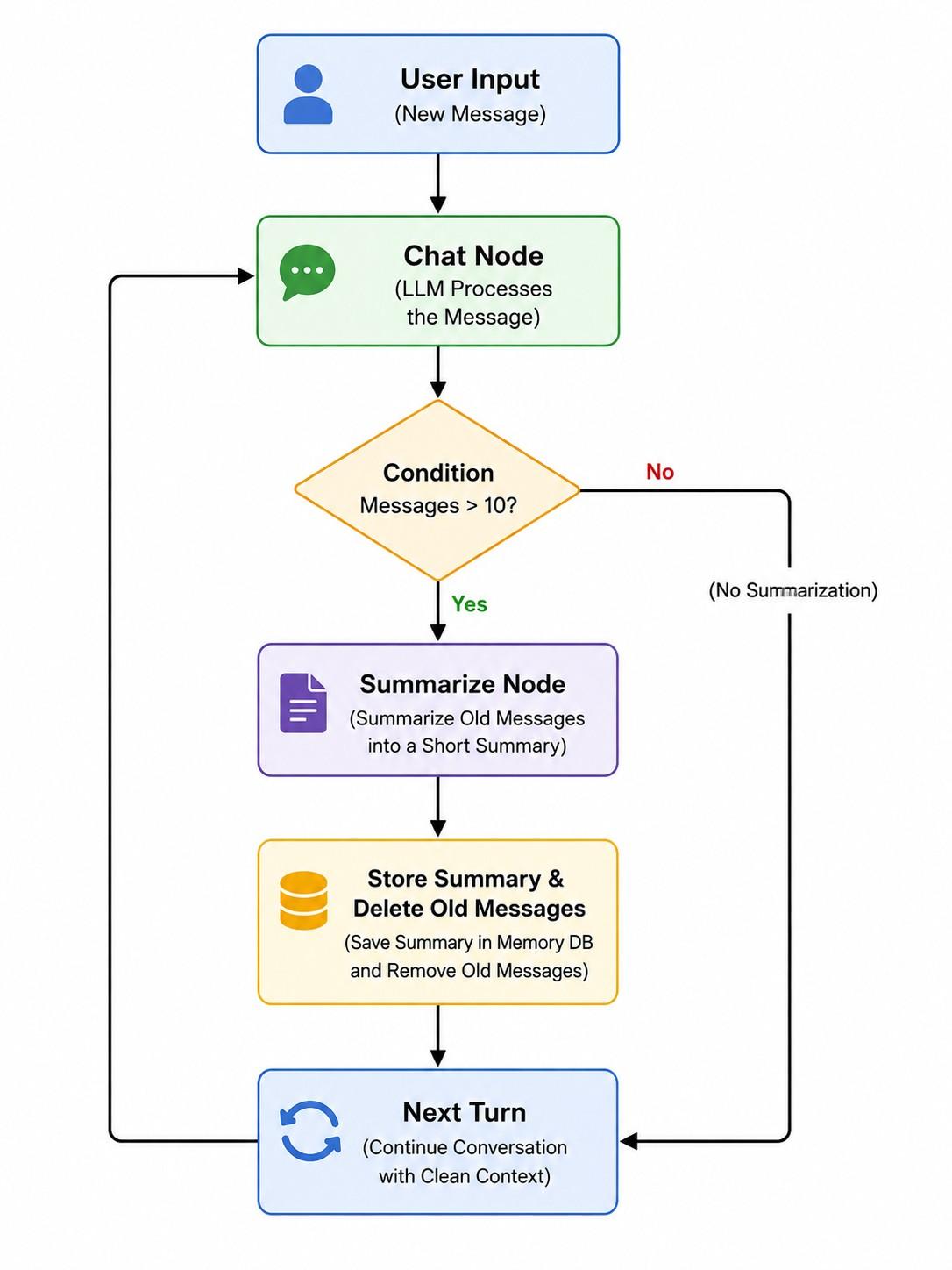
As a conversation grows, it eventually exceeds the LLM’s context window. We solve this using a Summary Node and Conditional Logic:
- Threshold Check: A conditional edge checks the
len(messages)in the state. - Summarization Node: If the count exceeds a limit (e.g., 6 messages), control routes to a
summarize_messagesnode. - State Update: The node summarizes the oldest messages, saves the summary in a
state["summary"]field, and deletes the old messages from themessageslist to free up space. - Injection: For the next turn, the summary is injected into the system prompt, ensuring the LLM has historical context without the “token bloat”.
49. In a Multi-Agent system, what is the role of a “Router” vs. a “Supervisor”?
- Router: A simple logic-based node (or a small LLM) that identifies the intent of a query and directs it to one specific agent. Once that agent finishes, the workflow usually ends.
- Supervisor: A more cognitive “Brain” that manages a team of agents. It decomposes a single query into multiple steps, calling Agent A, then Agent B based on A’s result, and then potentially looping back to A. Key Difference: Routing is a choice between paths; Supervision is the management of a complex, multi-step execution loop.
50. How would you monitor “Hallucination Rates” and “Tool Reliability” in a production LangGraph system?
This is handled via LangSmith Integration and Custom Trace Evaluators.
- Trace Visualization: Every node execution is captured as a “Run” within a “Trace”. You can visually inspect the exact “Thought” before a “Tool Call” to see if the LLM correctly interpreted the user’s intent.
- Evaluators: You can set up “LLM-as-a-judge” evaluators in LangSmith that automatically grade every response for “Groundedness” (no hallucinations) and “Utility”.
- Metadata Tagging: By tagging runs with
thread_idanduser_id, you can identify patterns—for instance, if the “Search Tool” fails more often for specific topics—allowing for data-driven prompt engineering improvements.
LangGraph & Agentic AI: Questions 51–60 (Advanced to Architect Level) #
51. In a Self-RAG architecture, what is the role of the “is_supported” node and how does it detect hallucinations?
The is_supported node acts as a Hallucination Grader. Its primary role is to ensure that every fact generated in the LLM’s response is strictly grounded in the retrieved documents.
- Mechanism: The node takes the generated Answer and the Context as input. The LLM is prompted to perform a fact-by-fact comparison.
- Output: It returns a verdict—Fully Supported, Partially Supported, or No Support.
- Action: If the result is “Partially Supported” or “No Support,” the graph is routed to a Revise Answer node to strip away any fabricated information before the user ever sees it.
52. Explain the logic of the “is_useful” node in Self-RAG. How does it handle a factually correct but unhelpful answer?
An answer can be 100% grounded in facts (no hallucinations) but still fail to address the user’s specific question. The is_useful node evaluates the utility of the grounded response.
- Scenario: If a user asks “Why does ice float?” and the retrieved context only talks about “Ice is solid water,” the LLM might generate a factually grounded answer that doesn’t explain the reason.
- Logic: If the node labels the answer as “Not Useful,” the agent recognizes a retrieval failure and triggers a Query Rewrite to fetch better, more specific documents from the vector store or the web.
53. How do you implement “Iteration Management” in Self-RAG to prevent infinite loops during query rewriting?
Since Self-RAG involves loops (Retrieval -> Generation -> Evaluation -> Rewrite -> Re-retrieve), there is a risk of an infinite loop if the LLM cannot find a useful answer.
- Solution: We include a
max_retriesorrewrite_triescounter in the graph’s State. - Code Implementation: Each time the “Query Rewrite” node is triggered, the counter increments. The conditional edge checking the
is_usefulresult also checks ifrewrite_tries >= MAX_LIMIT. If the limit is reached, it routes to a Finalize/No Answer Found node to terminate the execution gracefully.
54. Distinguish between the “Correct” and “Ambiguous” verdicts in Corrective RAG (CRAG).
In CRAG, the Retrieval Evaluator uses threshold-based scoring (e.g., Lower Threshold = 0.3, Upper Threshold = 0.7) to grade retrieval quality.
- Correct: Triggered if at least one document scores above the upper threshold (e.g., 0.8). The system trusts the internal knowledge and proceeds to refinement.
- Ambiguous: Triggered when no document is highly relevant, but some are “middle-of-the-road” (e.g., scoring 0.5). In this case, the system takes no chances: it uses the relevant parts of the internal documents and triggers a web search to supplement the context.
55. Describe the three-step “Knowledge Refinement” process used in the CRAG architecture.
When documents are relevant but contains “noise” (irrelevant text) due to fixed-size chunking, CRAG performs Knowledge Refinement:
- Decomposition: The retrieved document is broken into individual sentences or “strips”.
- Filtration: A specialized model (like a fine-tuned T5) evaluates each strip against the query. Irrelevant strips are discarded.
- Recombination: The remaining relevant strips are merged back into a concise “Knowledge Internal” context for the final generation.
56. In LangGraph HITL, what is the technical difference between an “Approval Pattern” and an “Edit Pattern”?
Both use the interrupt() function to pause the graph, but their data handling differs:
- Approval Pattern: The agent proposes an action (e.g., “Pay $500?”). The human provides a binary Yes/No via a
Command. If “No,” the agent might cancel or route to a failure node. - Edit Pattern: The agent produces a draft (e.g., a tweet). The human doesn’t just approve it; they modify the state. The modified text is sent back to the graph, and the agent uses the human-edited version for the next step (e.g., posting to social media).
57. How does the Command(resume=…) object interact with the interrupt() function internally?
This is the core mechanism for Stateful Resumption.
- Suspension: When
interrupt()is called, LangGraph saves the current state to the checkpointer and stops execution. The function call “hangs” conceptually. - Resumption: When the frontend sends a
Command(resume=user_input), LangGraph re-loads the state from the database and injectsuser_inputas the return value of theinterrupt()function. - Execution: The node then continues its logic using that return value (the human’s decision).
58. Why is the “Invalid Update Error” a common pitfall in parallel workflows, and how do Reducers solve it?
By default, LangGraph updates state by replacing the old value. In a parallel workflow, if Node A and Node B both finish simultaneously and return the full state dictionary, they will conflict on which version to save, causing an Invalid Update Error.
- Solution: Use Partial Updates (nodes return only the keys they changed) and Reducers. For example, if both nodes return a score, a reducer like
operator.addon a list ensures both scores are appended rather than one overwriting the other.
59. Explain the “Tool Discovery” phase in an MCP (Model Context Protocol) Client-Server setup.
Unlike traditional tools where schemas are hardcoded, MCP tools are dynamic.
- When the LangGraph MCP Client connects to a server (e.g., a SQLite or GitHub server), it performs a Handshake.
- The server sends a list of all available tool definitions (names, descriptions, and argument schemas) to the client.
- The client then binds these dynamic tools to the LLM on the fly, allowing the agent to use tools it didn’t even know existed until runtime.
60. From an architectural standpoint, why is “Persistence” the foundation for both Fault Tolerance and Time Travel?
Persistence involves taking a snapshot (checkpoint) of the state after every node execution and saving it to a durable database (PostgreSQL/SQLite).
- Fault Tolerance: If a system crashes, the system queries the DB for the last successful checkpoint and resumes execution from that specific node, rather than the beginning.
- Time Travel: Because every state transition is recorded with a unique ID, developers can “jump back” to any historical checkpoint to inspect the LLM’s reasoning or “fork” the state to test a different path.
Difficulty: Expert | 61-70 #
61. Multi-Agent Systems: Supervisor vs. Network (Mesh) Orchestration
- 1. Definition and Introduction: Multi-Agent Systems (MAS) involve decomposing a complex problem into sub-tasks handled by specialized agents. There are two primary architectural patterns:
- Supervisor Pattern: A central “Manager” agent decides which specialized worker to call next.
- Network (Mesh) Pattern: Agents communicate directly with one another, often passing the “baton” without a central controller.
- 2. Why This Concept Exists: A single LLM with 50 tools often experiences “tool confusion” and context window bloat. MAS modularizes the system, improving accuracy and reasoning.
- 3. Internal Working: In a Supervisor setup, the manager analyzes the user goal and routes to specialized Subgraphs. Once a worker finishes, control returns to the Supervisor to evaluate the result. In a Mesh setup, nodes have conditional edges to other agents directly.
- 4. Real-World Example: A “Software Development Team” where a Manager Agent directs a Coder Subgraph and a Reviewer Subgraph.
- 5. Production Architecture: Companies use Hub-and-Spoke (Supervisor) for high-stakes enterprise tasks to ensure a central “Brain” maintains a high-level view of the mission.
- 6. 2-Minute Interview Answer: “MAS scales AI agents by splitting tasks between specialized sub-agents. The Supervisor pattern uses a central LLM as an orchestrator to manage task delegation and result synthesis, which is ideal for complex, multi-step goals. The Network pattern allows direct agent-to-agent hand-offs, which is faster for sequential pipelines. In LangGraph, we implement these using Subgraphs, providing each agent with its own tools and isolated memory to prevent confusion.”
62. GraphRAG: Integrating Knowledge Graphs with LangGraph
- 1. Definition and Introduction: GraphRAG goes beyond standard vector-based RAG by utilizing Knowledge Graphs (KG). While vector RAG finds similar text, GraphRAG finds related entities and their relationships.
- 2. Problem It Solves: Standard RAG fails on “Global” questions (e.g., “What are the common themes across all these documents?”) because it only retrieves small, isolated chunks.
- 3. Internal Working:
- Extraction: An agent extracts entities and relationships from documents.
- Graph Construction: Data is stored in a Graph Database (like Neo4j).
- Traversal: When a query arrives, the LangGraph agent uses tools to “walk the graph” to find multi-hop connections.
- 4. Real-World Example: Analyzing legal cases where an agent must find a connection between a “Defendant,” a “Location,” and a “Previous Ruling” across 1,000 files.
- 5. 2-Minute Interview Answer: “GraphRAG is the next evolution of retrieval. Unlike vector search which finds ‘similar’ snippets, GraphRAG uses knowledge graphs to find ‘connected’ information. In LangGraph, we treat the Knowledge Graph as a Tool. The agent can query relationships (e.g., ‘Who is related to Project X?’) to build a much more comprehensive context than simple semantic search allows.”
63. Advanced Reducers: Merging Complex State in Parallel Flows
- 1. Definition and Introduction: A Reducer defines how the state is updated when a node returns a value. By default, LangGraph replaces the old state with the new update.
- 2. Logical Intuition: In parallel workflows (Fan-out), multiple nodes update the same key simultaneously. Without a reducer, the last node to finish “wins” and overwrites others.
- 3. Implementation: We use
Annotatedwith a function likeoperator.add. For complex merging, you can write custom Python functions to deduplicate tool outputs or average scores. - 4. Production Use Case: Aggregating scores from three different evaluators (Grammar, Clarity, Depth) into a single
individual_scoreslist in an essay grader. - 5. 2-Minute Interview Answer: “Reducers are the update logic for your graph’s state. In parallel workflows, they are critical to prevent ‘Invalid Update Errors.’ We use the
Annotatedtype to bind a reducer to a state key—for example,operator.addto append messages to a list. This ensures that when multiple agents work at once, their contributions are merged into the state rather than overwriting each other.”
64. Production Deployment: LangGraph, FastAPI, and Docker
- 1. Definition and Introduction: Moving from a Jupyter Notebook to a production API involves wrapping the LangGraph application in FastAPI and containerizing it with Docker.
- 2. Why This Concept Exists: Production systems require high availability, asynchronous processing, and scalability across multiple server instances.
- 3. Internal Working:
- FastAPI: Provides an async endpoint to trigger
.astream()or.ainvoke(). - PostgreSQL: Replaces SQLite for high-concurrency state persistence.
- Docker: Packages the code, environment variables, and database drivers into a portable image.
- FastAPI: Provides an async endpoint to trigger
- 4. Security Considerations: Use environment variables (
.env) to store API keys and implement OAuth2 for API access. - 5. 2-Minute Interview Answer: “To deploy LangGraph, we wrap it in a FastAPI backend to support asynchronous streaming and tool execution. We swap local SQLite persistence for a production-grade PostgreSQL database, typically run as a Docker container. This setup allows for horizontal scaling and ensures that our agent can handle hundreds of concurrent user threads reliably.”
65. Observability: Tracing Hallucinations with LangSmith
- 1. Definition and Introduction: Observability is the ability to understand an agent’s internal reasoning by examining traces and logs.
- 2. Problem It Solves: Agents are “black boxes.” If an agent gives a wrong answer, you need to know if the failure happened during Retrieval, Planning, or Tool Execution.
- 3. Internal Working: LangSmith captures every node execution as a “Run” within a “Trace”. You can see the exact input/output of every LLM call and identify latency bottlenecks.
- 4. Production Benefit: “LLM-as-a-judge” evaluators can automatically flag hallucinated responses in production logs.
- 5. 2-Minute Interview Answer: “Observability is non-negotiable for production agents. We integrate LangGraph with LangSmith to get end-to-end tracing. This allows us to see the exact ‘thought process’ of the agent before a tool call. If a failure occurs, we can pinpoint exactly which node—whether it’s the search tool or the summarizer—caused the error, allowing for data-driven debugging.”
66. Context Window Management: The Summary Node Pattern
- 1. Definition and Introduction: LLMs have a limited “Context Window” (token limit). As conversations grow, the system will eventually crash or “forget” the beginning.
- 2. Internal Working:
- Threshold: The graph checks if
len(messages)exceeds a limit (e.g., 6). - Summarize: A conditional edge routes to a
summarize_messagesnode. - Prune: The node generates a summary, stores it in the state, and deletes old messages from the list.
- Threshold: The graph checks if
- 3. 2-Minute Interview Answer: “To handle long-running conversations, we implement a ‘Summary Node.’ When the message history exceeds a token threshold, we trigger a node that summarizes the conversation so far. We then replace the old messages with this summary in the graph’s state. This keeps the prompt size manageable while ensuring the LLM retains all critical context from earlier in the session.”
67. Handling Tool Failures: The “Self-Healing” Agent Pattern
- 1. Definition and Introduction: A self-healing agent detects when a tool call (e.g., an API request) fails and attempts to recover autonomously.
- 2. Internal Working:
- Execution: A node attempts to call a tool.
- Catch Error: If an error occurs, the node returns the error message as the “Observation.”
- Reflect: The graph loops back to the LLM. The LLM sees the error (e.g., “API Rate Limit Exceeded”) and decides to Wait, Retry, or Try a Different Tool.
- 3. 2-Minute Interview Answer: “Self-healing is implemented using the Reflection pattern. If a ToolNode returns an error, we route that error back to the LLM. Instead of crashing, the agent reads the error message, reasons about the cause, and adapts—perhaps by trying an alternative tool or correcting its input arguments. This feedback loop makes the system significantly more robust.”
68. Multi-Modal Agents: Coordinating Text, Image, and Audio Nodes
- 1. Definition and Introduction: Multi-modal agents process and generate multiple types of data (text, images, audio) simultaneously.
- 2. Component Explanation: The LangGraph architecture uses specialized nodes for each modality. For example, a “Vision Node” uses GPT-4o to analyze an image, and a “Synthesis Node” combines that analysis with text data to reach a conclusion.
- 3. 2-Minute Interview Answer: “Architecting multi-modal agents in LangGraph involves creating specialized nodes for each data type. We use a central orchestrator to manage the flow—for instance, sending a user’s voice memo to a transcription node, then to the brain LLM for intent extraction, and finally to a vision tool if an image needs analysis. The shared ‘State’ acts as the bridge where text, image descriptions, and audio transcripts are merged.”
69. Strategic Reasoning: Implementing the Reflection Pattern
- 1. Definition and Introduction: The Reflection pattern involves an agent reviewing its own work before presenting it to the user.
- 2. Internal Working:
- Generator Node: Creates a draft.
- Evaluator Node: Critiques the draft based on strict guidelines.
- Optimization Loop: If the evaluator finds flaws, it provides feedback, and the graph loops back for a rewrite.
- 3. Use Case: Writing high-quality code where a “Compiler” node acts as the evaluator.
- 4. 2-Minute Interview Answer: “Reflection is the key to quality. In LangGraph, we build an iterative loop where one LLM generates an output and another ‘Critique’ LLM evaluates it against specific rubrics. If the work is sub-par, the agent provides itself with feedback and loops back to regenerate. This ‘Generate-Evaluate-Optimize’ cycle mimics human creative processes and results in much higher-quality outputs than one-shot generation.”
70. Model Context Protocol (MCP) in Enterprise Tooling
- 1. Definition and Introduction: MCP is a standardized protocol for connecting AI agents to external data and tools without custom “glue code”.
- 2. Problem It Solves: Traditionally, integrating a new tool (like Slack or a custom SQL DB) required writing a specific LangChain wrapper. MCP standardizes this into a Client-Server model.
- 3. Internal Working: A LangGraph agent acts as an MCP Client. It connects to an MCP Server, “discovers” available tools, and executes them via JSON-RPC.
- 4. 2-Minute Interview Answer: “MCP is the ‘USB port’ for the agentic era. It decouples the LangGraph agent from the tools it uses. By using an MCP Client, our agent can connect to any remote server and automatically discover its capabilities. This allows us to update or swap our internal tools—like our database or search provider—without changing a single line of the agent’s core reasoning logic.”
Expert Level: Scaling, Self-Correction, and Production Performance (Questions 71–80) #
71. Implementing Advanced State Pruning: The Summary Node Pattern
1. Definition and Introduction The Summary Node Pattern is an architectural strategy used to manage the limited context windows of Large Language Models (LLMs) in long-running agentic sessions. As a conversation grows, the accumulated message history eventually exceeds the model’s token limit, leading to “Context Overflow” errors or the model “forgetting” the beginning of the interaction.
2. Why This Concept Exists LLMs are mathematically constrained by a maximum token count (e.g., 8k, 32k, or 128k). In production, an agent might engage in hundreds of turns. Simply truncating the oldest messages results in the loss of critical instructions or user preferences established early in the chat.
3. Problem It Solves
- Token Bloat: Prevents the system from sending massive, expensive prompts to the API.
- Context Fragmentation: Ensures that the “essence” of the past 50 messages is preserved in a concise summary rather than just being deleted.
4. Internal Working and Detailed Workflow
- Threshold Monitoring: A conditional edge monitors the state (e.g.,
len(state['messages']) > 10). - Routing: If the threshold is hit, the graph routes to a
summarize_messagesnode. - Compression: The node takes the oldest N messages and prompts an LLM: “Summarize the core facts and decisions made in this conversation so far.”
- State Update: The summary is saved in a dedicated
state['summary']field. - Pruning: The processed messages are removed from the main
messageslist using theRemoveMessageutility.
5. Architecture Diagram (ASCII)
6. Python & LangGraph Implementation
from langchain_core.messages import RemoveMessage

def summarize_messages(state: State):
    # 1. Get existing summary
    summary = state.get("summary", "")

    # 2. Create prompt for compression
    if summary:
        prompt = f"Extend this summary with new info: {summary}\nMsgs: {state['messages'][:-2]}"
    else:
        prompt = f"Summarize this: {state['messages'][:-2]}"

    # 3. Generate and Update
    new_summary = model.invoke(prompt).content

    # 4. Remove all but last 2 messages to save space
    delete_msgs = [RemoveMessage(id=m.id) for m in state['messages'][:-2]]
    return {"summary": new_summary, "messages": delete_msgs}
7. 2-Minute Interview Answer “In production, we use the Summary Node pattern to handle the Context Window problem. When a conversation gets too long, we trigger a specific node that summarizes the history. We then store that summary in the graph state and use RemoveMessage to delete the old tokens from the message list. In the next turn, we inject this summary into the system prompt. This allows the agent to maintain long-term context while keeping API costs low and avoiding model crashes due to token limits.”
72. Deterministic vs. Probabilistic Evaluation in Agentic Systems
1. Definition and Introduction This concept explores the fundamental challenge of testing AI agents. Deterministic Evaluation refers to standard unit testing where an input always produces a fixed output (e.g., 2+2=4). Probabilistic Evaluation acknowledges that LLMs are non-deterministic and requires statistical or “LLM-as-a-judge” techniques to measure quality across multiple runs.
2. Problem It Solves Traditional unit tests fail for agents because the same prompt can yield slightly different phrasing every time. If you test for an exact string match, your tests will flaky. Probabilistic evaluation provides an objective way to measure Faithfulness and Relevance.
3. Internal Working with Detailed Workflow
- Tracing: Using LangSmith to capture internal “thoughts” and “tool calls.”
- Benchmarking: Running a “Gold Standard” dataset (Input vs. Expected Reasoning) through the graph.
- Grading: A “Judge LLM” (usually a more powerful model like GPT-4o) evaluates the “Student Agent’s” output based on a rubric (e.g., “Did the agent use the Search tool?”).
4. 2-Minute Interview Answer “Because LLMs are non-deterministic, we cannot rely on simple string-matching unit tests. Instead, we use LangSmith for probabilistic evaluation. We define ‘Gold Standard’ datasets and use an ‘LLM-as-a-judge’ to score the agent’s performance on dimensions like groundedness and utility. This shifts debugging from ‘looking at one error’ to ‘monitoring statistical drift’ in production.”
73. Hierarchical State Management: Isolated vs. Shared Memory in Subgraphs
1. Definition and Introduction This architectural decision determines how data flows between a Parent Graph and its Subgraphs.
- Isolated State: The subgraph has its own schema and does not see the parent’s variables.
- Shared State: The subgraph and parent use the same
TypedDictand keys.
2. Problem It Solves In complex Multi-Agent Systems, “Shared State” can lead to “State Pollution” where a sub-agent accidentally overwrites a critical parent variable. Isolation provides encapsulation, making agents more reusable across different projects.
3. Implementation Logic
- Isolated: Parent calls
subgraph.invoke({"input": parent_val}). - Shared: Parent adds the subgraph directly as a node using
builder.add_node("worker", subgraph).
4. 2-Minute Interview Answer “In LangGraph, subgraphs can be implemented with isolated or shared states. Isolated states provide better modularity and prevent ‘state pollution,’ as the sub-agent only sees what is explicitly passed to it. Shared states are more efficient for tightly coupled agents where the sub-agent needs the full conversation history. For enterprise systems, I prefer isolated states for workers to ensure they are easily testable as independent units.”
74. Orchestrating Tool-Augmented Chatbots with a Feedback Loop
1. Definition and Introduction A Tool Feedback Loop is a graph structure where the output of a ToolNode is routed back to the ChatNode rather than the END node.
2. Problem It Solves
- Technical Jargon: Raw tool outputs are often JSON (e.g.,
{"temp": 300.15}). Users want “It is 27°C.” - Multi-Step Reasoning: If a user asks “Find X and then do Y with it,” the agent needs to “see” the result of X before it can plan the execution of Y.
3. Internal Working The tools_condition checks if the LLM generated a tool_call. If it did, it routes to ToolNode. The ToolNode executes and its results are added to the messages list. The edge from ToolNode points back to the LLM, allowing it to “read” its own tool’s result and synthesize a natural language response.
4. 2-Minute Interview Answer “A common mistake in agent design is routing a ToolNode directly to the END node. This results in the user seeing raw JSON. The correct production pattern is a feedback loop: ToolNode always routes back to the LLM. This allows the LLM to interpret the tool’s data, check for errors, and provide a polished, human-friendly answer.”
75. Architecting Fault-Tolerant Long-Running Agents via PostgresSaver
1. Definition and Introduction PostgresSaver is a production-grade checkpointer that persists graph state in a PostgreSQL database. It replaces the volatile MemorySaver and the file-locked SqliteSaver.
2. Why This Concept Exists Enterprise agents often handle tasks like “Monitor this project for 30 days.” If the server restarts for a patch, the agent must not lose its progress.
3. Internal Working
- Concurrency: Uses row-level locking to allow multiple instances of the same agent to run in a cluster.
- Serialization: Converts the complex Python state (including tool objects and message classes) into binary blobs in SQL.
- Resumption: When re-invoked with a
thread_id, it performs aSELECTfor the latestcheckpoint_idand re-hydrates the graph.
4. 2-Minute Interview Answer “For production, we swap SQLite for PostgresSaver to ensure high availability and concurrency. Postgres allows our agents to be stateless on the compute side; if a Kubernetes pod dies, another one can pick up the exact same thread from the database. It provides the durability needed for long-running business processes that span multiple days.”
76. Strategic Reasoning with the Optimizer-Evaluator Pattern
1. Definition and Introduction This is an Iterative Workflow where one LLM (Generator) creates a draft and another (Evaluator) critiques it. The “Optimizer” then uses the critique to rewrite the draft.
2. Problem It Solves LLMs often struggle with “one-shot” perfection in creative or technical tasks (like writing code or complex essays). Iteration mimics the human “Draft -> Edit -> Publish” process.
3. Logical Intuition By separating the “Creator” from the “Critic,” you reduce the cognitive load on each model call. The critic can be given very strict rubrics (e.g., “Check for 10 specific grammatical rules”) that the creator might overlook while focusing on content.
4. 2-Minute Interview Answer “We use the Optimizer-Evaluator pattern for quality-critical tasks. In LangGraph, this is a loop: Node A generates, Node B evaluates against a rubric. If the score is below a threshold, a conditional edge loops back to Node A with specific feedback. To prevent infinite loops, we always implement a max_iterations counter in our state.”
77. The Internals of Model Context Protocol (MCP): Tool Discovery Handshakes
1. Definition and Introduction MCP standardizes how an agent (Client) interacts with a data source (Server). The Handshake is the initial communication where the Client asks the Server: “What can you do?”
2. Problem It Solves Decouples the agent’s logic from the tool’s implementation. If you change your database from SQLite to MongoDB, you only update the MCP Server; the LangGraph agent remains untouched.
3. Internal Working
- JSON-RPC: The client sends a
list_toolsrequest. - Schema Exchange: The server returns a list of tool names and Pydantic-like schemas.
- Binding: LangGraph dynamically creates tool objects and “binds” them to the LLM’s
toolsparameter at runtime.
4. 2-Minute Interview Answer “MCP is the ‘USB port’ for agents. During the discovery handshake, the LangGraph client connects to a server and automatically pulls in tool definitions. This makes our architecture highly modular—we can swap out internal enterprise tools without changing the core agent code, as long as they follow the MCP standard.”
78. Cross-Thread Reasoning: Moving from Short-Term to Long-Term Semantic Memory
1. Definition and Introduction Standard persistence is Thread-scoped (Short-Term). Long-Term Memory (LTM) is User-scoped, allowing an agent to remember info across completely different conversations.
2. Why This Concept Exists If User A tells the agent “I prefer Python” in Thread 1, the agent in Thread 2 (new session) will forget this unless LTM is implemented.
3. Internal Working
- Extraction: At the end of a thread, an LLM extracts “User Facts.”
- Vectorization: Facts are stored in a Memory Store (Vector DB) with a
user_idnamespace. - Retrieval: In any new thread, the system performs a Semantic Search on the Memory Store and injects the results into the System Prompt.
4. 2-Minute Interview Answer “Short-term memory is isolated to a single thread ID using checkpointers. To achieve cross-thread reasoning, we implement Long-Term Memory using a Memory Store. We extract ‘memories’ as embeddings and store them by user ID. Whenever a user starts a new chat, we query these memories to personalize the response, ensuring the agent remembers preferences established months ago.”
79. Real-Time Observability: Debugging Latency Culprits with LangSmith Traces
1. Definition and Introduction In a multi-node LangGraph, identifying why a response took 10 seconds is impossible without component-level tracing.
2. Internal Working LangSmith breaks down a single “Trace” (user interaction) into individual “Runs” (node executions).
- Latency Attribution: You can see that “Node: Search” took 8 seconds, while “Node: LLM” took only 1 second.
- Metadata: You can tag runs with
deployment_versionto see if a recent code update slowed down the system.
3. 2-Minute Interview Answer “Observability is the key to maintaining production agents. Using LangSmith, we can decompose a 10-minute latency issue into its individual components. For example, I once found that a ‘Google Drive Scan’ node was scanning the whole drive instead of one folder. Without a LangSmith trace, I would have been guessing; with it, I found the culprit in seconds.”
80. Parallel Workflow Synchronization: Preventing the Invalid Update Error
1. Definition and Introduction In LangGraph, if multiple nodes in a parallel branch try to update the same key by returning the full state, the system throws an Invalid Update Error.
2. Internal Working: The “Partial Update” Rule LangGraph uses the Pregel model, which requires deterministic state merging.
- The Conflict: Node A returns
{...all keys...}and Node B returns{...all keys...}. LangGraph doesn’t know which version of “unchanged” keys to trust. - The Solution: Nodes must return only the keys they updated (e.g.,
return {"score": 5}).
3. 2-Minute Interview Answer “The ‘Invalid Update Error’ happens in parallel workflows when nodes return the entire state dictionary instead of just their specific updates. To fix this, we follow the ‘Partial Update’ rule: nodes must only return a dictionary of the keys they modified. Combined with Reducers, this allows LangGraph to safely merge results from multiple simultaneous tasks.”
Expert Level: Production Architectures and Advanced Orchestration (Questions 81–90) #
81. The Supervisor Pattern: Building Hierarchical Multi-Agent Teams
1. Definition and Introduction The Supervisor Pattern is a high-level architectural design in Multi-Agent Systems (MAS) where a single “Manager” agent is responsible for task decomposition, delegation, and result synthesis. In this model, specialized “Worker” agents (often implemented as subgraphs) handle specific domains—like research, coding, or quality assurance—while the Supervisor maintains the high-level goal and decides which worker to call next.
2. Why This Concept Exists As the number of tools and tasks in an agentic system grows, a single LLM often suffers from “Cognitive Overload” or “Tool Confusion”. The Supervisor pattern modularizes the system, ensuring that the “Brain” only focuses on high-level orchestration, while the “Hands” focus on execution.
3. Internal Working and Detailed Workflow
- Decomposition: The Supervisor receives a complex goal (e.g., “Build a React app and deploy it”).
- Selection: It selects the “Coder” worker.
- Handoff: The graph routes the state to the Coder subgraph.
- Observation: The worker returns its output to the Supervisor.
- Evaluation: The Supervisor checks if the task is complete or if another worker (e.g., “DevOps”) is needed.
4. Architecture Diagram (ASCII)
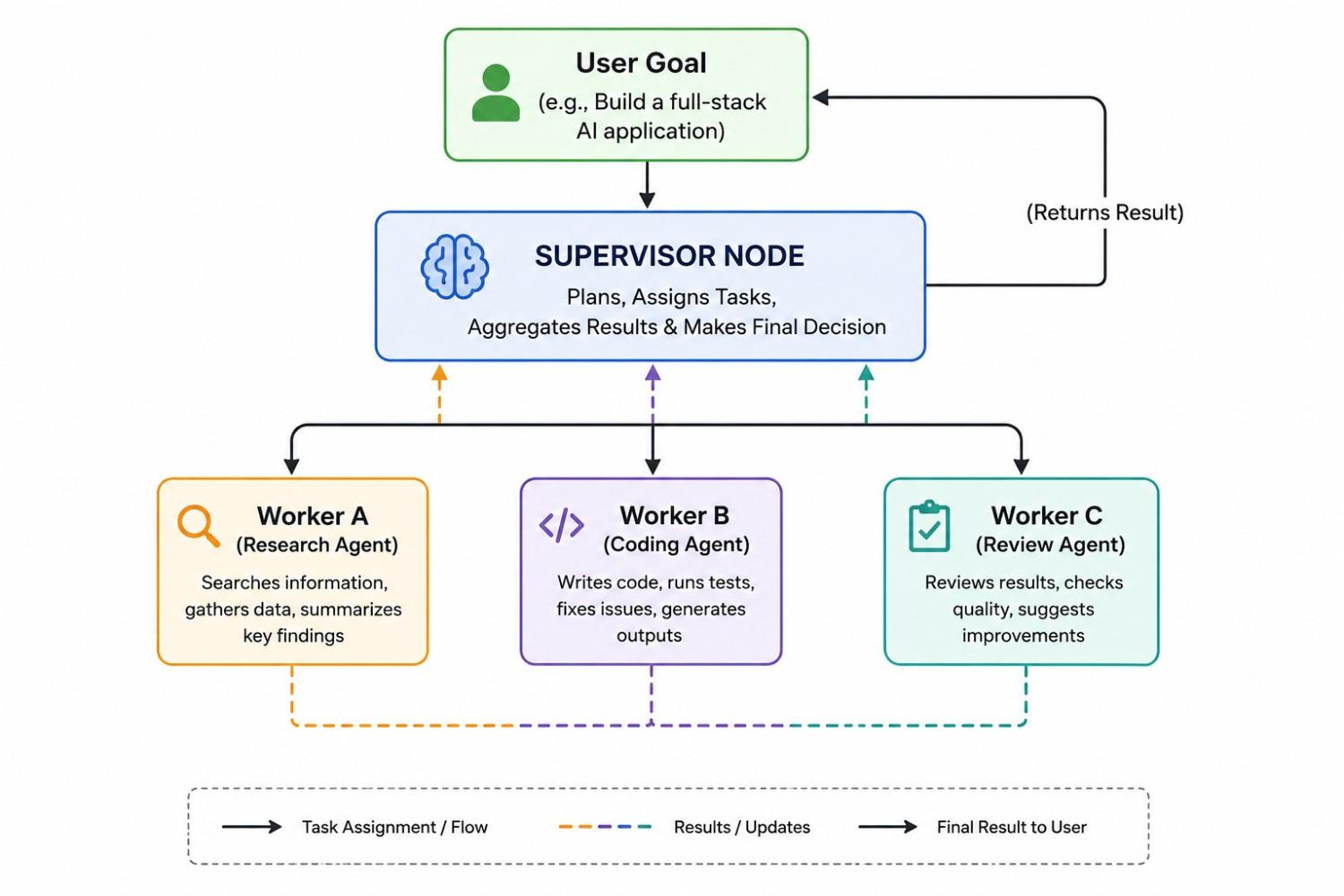
5. 2-Minute Interview Answer “In the Supervisor pattern, we use a central ‘Manager’ agent to orchestrate a team of specialized workers. This is essentially a ‘Hub-and-Spoke’ architecture where the Supervisor decides the next step based on the output of the previous worker. It solves the problem of tool confusion by isolating tools within subgraphs, allowing each worker to be a master of its specific domain while the Supervisor maintains the global context. This makes enterprise AI systems modular, easier to test, and highly scalable.”
82. Production Persistence: Transitioning from SQLite to PostgresSaver
1. Definition and Introduction Persistence in LangGraph involves taking “snapshots” of the graph’s state at every super-step and saving them to a database. In production, PostgresSaver is the industry standard, replacing the local, file-locked SqliteSaver used during development.
2. Why This Concept Exists Production environments typically run agents inside ephemeral containers (e.g., Kubernetes pods). If a pod restarts, any local SQLite file is lost. A centralized PostgreSQL database (like AWS RDS) ensures that conversation state survives across server restarts and supports high-concurrency access from multiple users.
3. Internal Working
- Serialization: LangGraph converts complex Python message objects into JSON/Binary blobs.
- Indexing: The state is stored against a
thread_idand acheckpoint_id. - Concurrency: Postgres handled row-level locking, ensuring that if two users talk to the same bot simultaneously, their states remain isolated and integral.
4. 2-Minute Interview Answer “While SQLite is great for prototyping, production systems require PostgresSaver. This provides horizontal scalability and high availability. Architecturally, it decouples the ‘Compute’ (your Python code) from the ‘Memory’ (the database), allowing agents to resume long-running tasks even if the specific server they were running on crashes or is redeployed. We use thread IDs to manage thousands of isolated user sessions within a single resilient PostgreSQL instance.”
83. Asynchronous Flow Control: Implementing astream for High-Concurrency UI
1. Definition and Introduction Asynchronous Streaming (astream) is a non-blocking execution model where LangGraph yields updates (tokens or node completions) as they occur without waiting for the entire graph to finish.
2. Problem It Solves LLM responses and multi-step tool executions can take significant time. In a synchronous system, the frontend “hangs” and the user is left guessing. astream reduces “Perceived Latency” by showing progress in real-time.
3. Internal Working
- Asyncio Integration: The backend uses
async defnodes. - Generator Yielding: The
.astream()method returns an asynchronous generator. - Frontend Updates: Frameworks like FastAPI transmit these chunks via Server-Sent Events (SSE) or WebSockets to the UI.
4. 2-Minute Interview Answer “For production-grade UIs, we use .astream() rather than .invoke(). This allows us to provide node-level updates (e.g., ‘Agent is searching…’) and token-level streaming simultaneously. Technically, this relies on Python’s asyncio and generator objects, ensuring that our backend remains responsive while the agent is performing heavy-duty API calls or long-running reasoning tasks. It’s the difference between a bot that feels ‘frozen’ and one that feels ‘alive’.”
84. Corrective RAG (CRAG): The Internal Logic of Knowledge Refinement
1. Definition and Introduction Corrective RAG (CRAG) is an advanced retrieval strategy that evaluates the relevance of retrieved documents and “corrects” the context if the retrieval is noisy or irrelevant.
2. Core Components: Document Stripping If a document is relevant but contains too much “noise” (extra text that confuses the LLM), CRAG performs Knowledge Refinement:
- Decomposition: The document is split into individual sentences or “strips”.
- Filtration: A small model grades each strip against the query.
- Recombination: Only the “good” strips are kept to form the final context.
3. 2-Minute Interview Answer “CRAG solves the ‘Blind Trust’ problem of traditional RAG where an LLM is forced to answer from irrelevant documents. It adds a ‘Retrieval Evaluator’ node that scores documents as Correct, Incorrect, or Ambiguous. If a document is correct but noisy, CRAG performs Knowledge Refinement by stripping the text down to its most relevant sentences before sending it to the generator. This significantly reduces hallucinations and improves answer precision.”
85. Self-RAG: Designing the Self-Reflection Loop
1. Definition and Introduction Self-RAG is a self-reflective architecture where the agent critiques its own generated output based on groundedness and utility.
2. Internal Working: The Reflection Nodes
- is_supported: A node that checks if every fact in the answer exists in the retrieved documents (Fact-checking).
- is_useful: A node that checks if the answer actually satisfies the user’s question, even if it’s factually correct.
3. 2-Minute Interview Answer “Self-RAG makes an AI agent its own toughest critic. After generating an answer, the graph enters a ‘Self-Reflection’ loop. We use specialized nodes to grade the response: the is_supported node detects hallucinations by checking facts against the context, while the is_useful node ensures the answer isn’t just correct but helpful. If either check fails, the agent loops back to rewrite the answer or even re-search the web for better info.”
86. Model Context Protocol (MCP): Standardizing Multi-Server Tool Orchestration
1. Definition and Introduction MCP is an open protocol designed to standardize how AI agents discover and interact with tools hosted on remote servers.
2. Why It Matters for Enterprise Traditionally, connecting a LangGraph agent to Slack or a SQL DB required custom wrapper code. With MCP, any server following the standard can “handshake” with the agent, providing it with tool definitions dynamically.
3. 2-Minute Interview Answer “MCP is essentially the ‘USB port’ for the AI era. It decouples the agent’s logic from the tools it uses. Architecturally, our LangGraph agent acts as an MCP Client that can connect to multiple MCP Servers—such as a database server and an email server—simultaneously. This makes our systems future-proof: if a tool provider updates their API, we only update the MCP Server, and the agent’s reasoning logic remains unchanged.”
87. The Command Object: Navigating Dynamic Routing and HITL Resumption
1. Definition and Introduction In LangGraph, the Command object is the mechanism used to send external data back into a paused graph, particularly during Human-in-the-Loop (HITL) interactions.
2. Internal Working
- Pause: A node calls
interrupt(), saving state and stopping execution. - Response: The human provides input (e.g., “Approve”).
- Resume: The application backend calls the graph using
graph.invoke(Command(resume=input)). - Injection: LangGraph injects the input as the return value of the
interrupt()function, allowing the node to proceed.
4. 2-Minute Interview Answer “The Command object is the key to stateful resumption. In HITL workflows, when an agent hits an interrupt(), the graph goes to sleep. To wake it up, we don’t just call it again with the original input; we use a Command object with a resume parameter. This allows us to pass human decisions—like an approval or a text edit—directly back into the specific node that was waiting, enabling seamless ‘Cyborg’ workflows.”
88. Advanced Reducers: Sequence and Metadata Management in Shared States
1. Definition and Introduction Reducers define how updates are merged into the graph state. While operator.add is common for message lists, expert implementations use custom functions to handle complex data structures like sets or deduplicated histories.
2. Logical Intuition: Parallel Conflicts In parallel workflows, multiple nodes might return updates for the same key at the same time. A reducer acts as a “conflict resolution policy” to merge these parallel updates without overwriting data.
3. 2-Minute Interview Answer “Reducers are the update logic for your graph’s state. We use Python’s Annotated type to bind a reducer function to a state key. For example, if multiple parallel agents are contributing to a research report, a simple ‘overwrite’ would lose data. We use a reducer like add_messages or a custom function to append their findings into a list, ensuring that every agent’s contribution is preserved and synchronized during the next super-step.”
89. GraphRAG: Enhancing LangGraph with Knowledge Graph Traversal
1. Definition and Introduction GraphRAG combines Knowledge Graphs (KG) with LLM retrieval. While vector RAG finds “similar” text, GraphRAG finds “connected” entities and relationships.
2. Why It Is Needed Vector search struggles with “Global” questions like “What are the core themes in all these documents?” because it only sees local snippets. GraphRAG allows the agent to “walk” the graph to connect disparate ideas.
3. 2-Minute Interview Answer “GraphRAG is the next step beyond simple semantic search. In LangGraph, we treat the Knowledge Graph as a high-powered Tool. Instead of just retrieving chunks, the agent can query for relationships—for instance, ‘Find all companies connected to Project X’. This allows for ‘multi-hop’ reasoning that standard vector-based RAG simply cannot achieve, making it ideal for legal, scientific, or complex project management agents.”
90. LLMOps with LangSmith: Automated Evaluation and Thread Trace Management
1. Definition and Introduction LangSmith provides the observability and evaluation layer for LangGraph applications. It organizes executions into Projects, Threads, and Traces.
2. Internal Working
- Tracing: Every node execution is captured as a “Run”.
- Thread ID: Metadata tagging allows LangSmith to group multiple turns into a single conversation view.
- Evaluators: “LLM-as-a-judge” nodes can automatically score production traces for groundedness or toxicity.
3. 2-Minute Interview Answer “LangSmith is essential for debugging non-deterministic agents. By passing the thread_id in the graph configuration, we can view the entire history of an agent’s reasoning across multiple turns in the LangSmith dashboard. This allows us to track ‘Hallucination Rates’ and ‘Tool Reliability’ in real-time. If a failure occurs, we can pinpoint exactly which node in the graph failed, allowing for data-driven prompt engineering rather than trial-and-error.”
Architect Level: Enterprise Systems and Future Paradigms (Questions 91–100) #
91. Architecting for High Availability: Scaling LangGraph with PostgreSQL and Redis
1. Definition and Introduction At the architectural level, High Availability (HA) in LangGraph refers to the system’s ability to maintain continuous operation and state integrity even in the face of component failures or massive traffic spikes. In production, this requires moving away from local file-based storage (SQLite) to distributed, industrial-grade persistence layers like PostgreSQL (via PostgresSaver) and Redis.
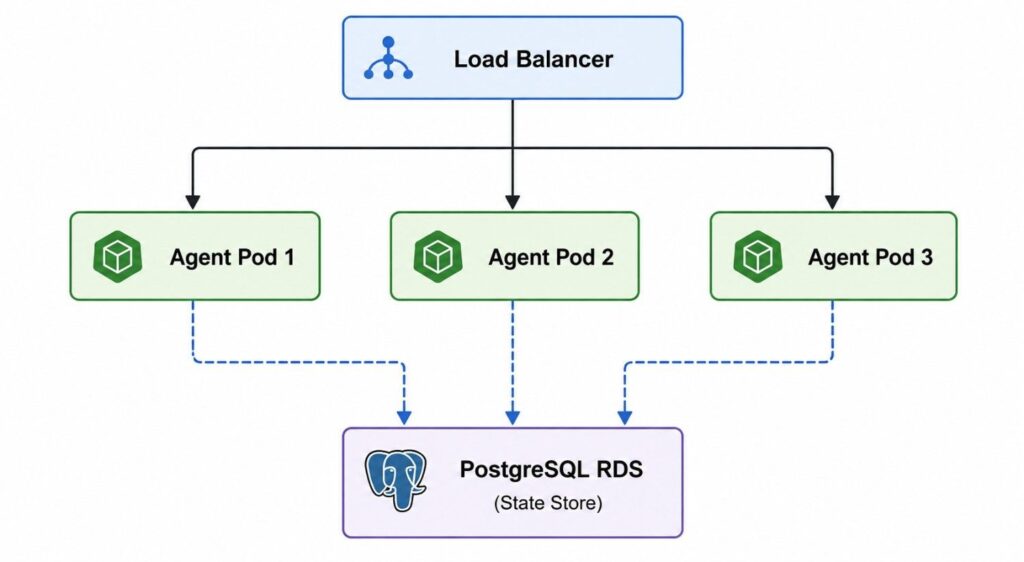
2. Why This Concept Exists AI agents in the enterprise are often deployed across clusters (e.g., Kubernetes). If Agent Instance A handles a request and then the pod restarts, the state must be retrievable by Agent Instance B. A shared database becomes the “externalized RAM” of the agentic system.
3. Problem It Solves
- Instance Volatility: Decouples compute from memory.
- Concurrency Bottlenecks: PostgreSQL manages row-level locking, preventing “State Pollution” when multiple users or parallel processes update the same thread.
4. Internal Working: The Checkpointing Handshake
- Distributed Lock: When a request arrives with a
thread_id, the checkpointer attempts to acquire a lock in the DB. - Snapshot Fetch: The system pulls the latest
checkpoint_idfor that thread. - State Rehydration: The graph is loaded into memory with the historical context.
- Commit on Super-Step: After every node execution (super-step), the new state is serialized and pushed back to the DB.
5. Architecture Diagram (ASCII)
6. Python Implementation (Architectural snippet)
from langgraph.checkpoint.postgres import PostgresSaver
from psycopg_pool import ConnectionPool

# Connection pool for high-concurrency
pool = ConnectionPool(conninfo="postgresql://...")
checkpointer = PostgresSaver(pool)

# HA Graph Compilation
app = workflow.compile(checkpointer=checkpointer)
7. 2-Minute Interview Answer “Scaling LangGraph for enterprise workloads requires a shift from local persistence to distributed state management. As an architect, I swap SQLite for PostgresSaver backed by a managed service like AWS RDS. This ensures that our agents are stateless; any pod in a Kubernetes cluster can pick up any conversation thread. We also implement connection pooling to handle high-concurrency locking, ensuring that state transitions remain ACID-compliant even under heavy load”.
92. CEO-Manager-Worker: Orchestrating Hierarchical Multi-Agent Systems
1. Definition and Introduction The Hierarchical Multi-Agent Pattern is an advanced orchestration strategy where agents are organized in a “Chain of Command.” A high-level CEO Agent manages Manager Agents, who in turn oversee specialized Worker Agents (implemented as subgraphs).
2. Why This Concept Exists As tasks grow in complexity, a single LLM with too many tools suffers from “Tool Confusion” and context window overflow. Hierarchy enforces Encapsulation and Cognitive Offloading.
3. Internal Working: The Delegation Loop
- CEO: Receives the high-level goal and creates a strategic plan.
- Manager: Receives sub-goals from the CEO and routes them to the relevant Worker Subgraph.
- Worker: Executes specific tools (e.g., SQL search, Web search) and returns raw data.
- Synthesis: The Manager summarizes the data for the CEO, who makes the final decision.
4. 2-Minute Interview Answer “In hierarchical systems, we use Subgraphs to isolate complexity. The CEO agent handles high-level reasoning and planning, delegating execution to specialized workers. This modularity means the ‘Coding Worker’ only needs access to the Python interpreter tool, while the ‘Research Worker’ only uses the Web Search tool. This prevents the ‘Brain’ from getting distracted by irrelevant tools and allows us to scale to hundreds of specialized functions without hitting context limits”.
93. Enterprise Reliability: Implementing HITL for High-Stakes Operations
1. Definition and Introduction Human-in-the-Loop (HITL) is the design of “Intervention Points” within an autonomous graph. For enterprise actions—like financial transfers or legal filings—the agent must pause and await explicit human verification.
2. Problem It Solves Eliminates “Agentic Drift” where an autonomous system makes a costly mistake due to a hallucination or API error.
3. Technical Mechanism: interrupt() and Command
- The Pause: The node calls
interrupt(). LangGraph takes a checkpoint and stops execution. - The Response: The human provides input via a UI.
- The Resume: The graph is re-invoked using the
Commandobject, which injects the human’s decision back into the exact node that was waiting.
4. 2-Minute Interview Answer “HITL is a first-class citizen in LangGraph. For high-stakes nodes, we use the interrupt() function to pause the graph and save its state to the checkpointer. The system then enters a wait state until a human sends a Command with the approval. This architecture guarantees that critical business logic is never fully autonomous, providing a safety ‘kill-switch’ or verification layer in production”.
94. Designing the MCP Ecosystem for Modular Enterprise Tooling
1. Definition and Introduction The Model Context Protocol (MCP) is a standardized interface that decouples the “Reasoning Engine” (LangGraph) from the “Execution Engine” (Tool Servers).
2. Problem It Solves Traditionally, every tool (Slack, Jira, SQL) required a custom LangChain wrapper. MCP allows an agent to connect to an MCP Server and “discover” its capabilities dynamically.
3. Internal Working: Multi-Server Orchestration An architect builds an MCP Client that handshakes with multiple remote servers. The client pull schemas for all available tools and binds them to the LLM. If the Slack API changes, you only update the MCP Server; the LangGraph logic remains untouched.
4. 2-Minute Interview Answer “MCP is the ‘USB port’ for agents. It allows our LangGraph applications to be completely tool-agnostic. We build independent MCP Servers for different departments—one for HR, one for Finance. The agent connects to these servers as a client, discovers the tools via JSON-RPC, and executes them. This decoupling means we can update or swap out our backend infrastructure without changing a single line of agent code”.
95. Long-Term Memory Architecture: Managing Memory at Scale
1. Definition and Introduction Long-Term Memory (LTM) is a user-scoped persistence layer that spans across different threads. While checkpointers handle thread-level short-term context, LTM uses a Memory Store to manage user preferences and facts indefinitely.
2. Internal Working: The 3-Step Pipeline
- Fact Extraction: At the end of a session, an LLM extracts “user facts” worth remembering.
- Namespace Storage: Data is stored in a
Store(e.g., Postgres) under a user-specific namespace. - Semantic Retrieval: In future threads, the system performs a semantic search on the user’s past memories and injects them into the current system prompt for personalization.
3. 2-Minute Interview Answer “LTM is essential for building agents that ‘grow’ with the user. We implement this using a Memory Store that extracts facts from conversations—like ‘User prefers Python’—and stores them as embeddings. In any new chat thread, we query these memories and inject them into the system prompt. This allows a new thread to benefit from months of previous interaction history, making the agent feel personal and context-aware across every touchpoint”.
96. Cost-Aware Architecture: Managing Token Budgets in Complex Graphs
1. Definition and Introduction In an agentic system where loops can run indefinitely (e.g., Self-RAG), cost control is an architectural requirement. Every LLM call consumes tokens, and deep recursion can lead to massive bills.
2. Strategies for Optimization
- Max Iterations: Always implement a hard-coded iteration counter in the
Stateto break infinite loops. - State Pruning: Use “Summary Nodes” to condense message history, reducing the token count of subsequent prompts.
- Model Tiering: Route simple tasks (math, parsing) to smaller models (GPT-4o-mini) and reserve large models for planning.
3. 2-Minute Interview Answer “As an architect, I prevent ‘token bleed’ by enforcing hard limits on graph cycles. Every iterative workflow must have a max_iterations check in its routing logic. Furthermore, we use state pruning via Summary Nodes to keep the context window lean. By monitoring token usage per node in LangSmith, we identify expensive nodes and swap them for smaller models where reasoning requirements are low, optimizing our production ROI”.
97. Advanced Observability: Architecting LLMOps with LangSmith
1. Definition and Introduction Observability in agentic systems involves tracing the path of data through non-linear nodes and loops to identify where reasoning failures occur.
2. Component Breakdown
- Traces: A single end-to-end execution of a user query.
- Threads: All traces belonging to a single user session.
- Evaluators: Automated “LLM-as-a-judge” nodes that grade traces for groundedness or hallucination.
3. 2-Minute Interview Answer “We integrate LangSmith to turn our agents from ‘black boxes’ into transparent systems. By tagging every graph invocation with a thread_id and deployment_version, we can view the entire reasoning history in the LangSmith dashboard. This allows us to track real-time metrics like ‘Hallucination Rate’ and ‘Tool Latency,’ enabling a data-driven approach to prompt engineering and agent optimization”.
98. Custom Persistence: Designing High-Performance Checkpointers
1. Definition and Logical Intuition Standard checkpointers like SqliteSaver are file-based. For high-performance apps requiring millisecond-level responsiveness, architects design custom checkpointers using In-Memory Databases (like Redis) or specialized NoSQL stores.
2. Key Consideration: Pruning In high-volume systems, checkpoints can grow to terabytes. An architect must implement a Pruning Strategy to delete old checkpoints after they are no longer needed (e.g., older than 30 days) to maintain performance and keep storage costs low.
99. Hybrid RAG: Integrating Knowledge Graphs and Vector DBs
1. Definition and Introduction Hybrid RAG (or GraphRAG) is an architecture that combines the semantic search of Vector DBs with the structured relationship-mapping of Knowledge Graphs.
2. Internal Working
- Local Search: Vector DB finds specific text snippets.
- Global Search: Knowledge Graph finds multi-hop connections (e.g., “Find all documents related to the CEO’s past projects”).
- Correction: CRAG/Self-RAG nodes evaluate the combined context for relevance before generation.
100. Deployment & Infrastructure: Containerizing LangGraph at Scale
1. Definition and Introduction Scaling LangGraph involves containerizing the application using Docker and exposing it via an asynchronous backend like FastAPI.
2. Production Roadmap
- Backend: FastAPI provides async endpoints (
astream,ainvoke). - Persistence: External PostgreSQL instance for shared state.
- Frontend: React or Next.js to handle asynchronous token streams for the user.
3. 2-Minute Interview Answer “To deploy at scale, I wrap the LangGraph app in a Docker container and expose it through FastAPI’s async interface. We use astream to provide token-level feedback to the UI, reducing perceived latency. By externalizing our state to a PostgreSQL RDS instance and our tools to MCP Servers, we achieve a highly modular, horizontally scalable architecture capable of supporting millions of user interactions”.
LangGraph Quiz #
Q.1 What is the primary characteristic that distinguishes Self-RAG from traditional RAG architectures?
- A fixed linear flow that prevents looping or revising previously generated answers.
- The ability of the LLM to actively judge its own retrieval evidence and generated responses.
- The exclusion of an LLM's parametric knowledge during the generation process.
- The use of multiple vector databases for simultaneous retrieval.
Explanation
Self-RAG (Self-Reflective RAG) extends traditional RAG by enabling the LLM to evaluate the quality of retrieved documents and its own generated answers. It uses ‘self-reflection’ nodes to check if retrieval is necessary, if documents are relevant, and if the final response is grounded in facts and useful to the user.
Q.2 Which of the following is NOT one of the six key characteristics used to verify if a system is truly 'Agentic AI'?
- Autonomy and Goal-Orientation
- Planning and Reasoning
- Deterministic Scripting
- Adaptability and Context-Awareness
Explanation
According to the framework, Agentic AI is defined by six traits: Autonomy (independent action), Goal-Orientation (focus on objectives), Planning (breaking goals into steps), Reasoning (intelligent decision-making), Adaptability (responding to unexpected changes), and Context-Awareness (retaining memory).
Q.3 What is the fundamental architectural difference between LangChain and LangGraph?
- LangChain is stateful by design, while LangGraph is stateless.
- LangChain only supports Python, whereas LangGraph supports multiple languages.
- LangChain is best for linear chains, whereas LangGraph handles cyclical, non-linear workflows.
- LangGraph is a replacement for LangChain, making LangChain obsolete.
Explanation
LangChain is primarily designed for linear, sequential processing (stateless). LangGraph is an orchestration framework built ON TOP OF LangChain that treats applications as stateful directed graphs, enabling loops, branching, and complex state management essential for agents.
Q.4 In a Corrective RAG (CRAG) workflow, what is the 'Retrieval Evaluator' responsible for?
- Generating the final human-friendly response.
- Determining if retrieved documents are Correct, Incorrect, or Ambiguous regarding a query.
- Calculating the total token cost of an LLM call.
- Converting user text queries into vector embeddings.
Explanation
CRAG introduces a Retrieval Evaluator model that sits between retrieval and generation. It scores retrieved documents. If they are ‘Correct’, it proceeds; if ‘Incorrect’, it triggers a web search; if ‘Ambiguous’, it uses a merge of both.
Q.5 What is a 'Reducer' function in LangGraph used for?
- Reducing the number of tokens in a prompt to save costs.
- Defining how state updates are applied, such as appending to a list rather than overwriting it.
- Converting a complex graph into a simpler linear chain.
- Compressing large PDF documents before they are loaded into a vector store.
Explanation
Reducers determine how state updates are merged. By default, LangGraph replaces old values. Using a reducer (like operator.add with the Annotated type) allows for complex merging, such as accumulating a list of feedback scores from parallel evaluation nodes.
Q.6 Which prebuilt LangGraph component is specifically designed to route execution based on whether an LLM wants to use a tool?
- START
- interrupt()
- tools_condition
- ToolNode
Explanation
tools_condition is a prebuilt routing function that checks the LLM’s response for tool_calls. If tool calls are present, it routes to the ‘tools’ node; otherwise, it routes the workflow to END.
Q.7 What happens when the interrupt() function is called within a LangGraph node?
- The graph immediately terminates and returns an error message.
- The execution pauses, saves a checkpoint of the current state, and waits for a user 'Command'.
- The graph automatically retries the last task with a different LLM model.
- It triggers a web search to fill in missing information in the state.
Explanation
interrupt() is used for Human-in-the-Loop (HITL). It suspends graph execution and triggers a checkpoint save. The system ‘goes to sleep’ and only resumes when a human provides input through a Command object.
Q.8 What is the primary purpose of a 'Thread ID' in LangGraph persistence?
- To identify which LLM model (e.g., GPT-4 vs. Claude) is being used.
- To track the execution speed of individual nodes in milliseconds.
- To isolate independent conversation histories for different users or sessions.
- To define the maximum number of parallel tasks allowed.
Explanation
A thread_id acts as a unique identifier for a specific conversation session. Persistence mechanisms like MemorySaver or SqliteSaver use this ID to store and retrieve the state unique to that specific user interaction, preventing data from mixing between users.
Q.9 In advanced RAG, what is 'Knowledge Refinement' within the CRAG architecture?
- A method to increase the temperature of an LLM for more creative answers.
- The process of stripping documents into sentences, filtering for relevance, and recombining them.
- A technique for fine-tuning an embedding model on domain-specific data.
- The removal of all parametric knowledge from the LLM to prevent hallucinations.
Explanation
Knowledge Refinement occurs when retrieved documents are relevant but ‘noisy’. The system decomposes the document into ‘strips’ (sentences), filters out irrelevant strips using an evaluator, and recombines the remaining content into a concise context for the generator.
Q.10 Why is 'Streaming' considered essential for production-grade AI agents?
- It reduces the actual token cost of calling the LLM.
- It allows the model to access the internet more quickly.
- It provides a 'typewriter effect' that reduces perceived latency for the user.
- It prevents the LLM from hallucinating by slowing down output generation.
Explanation
Streaming sends tokens as they are generated rather than waiting for the full response. This improves user experience by providing immediate feedback (‘typewriter effect’), reducing the frustration caused by long wait times for complex generations.
Q.11 Which LangSmith concept represents a single full execution of an LLM application from start to finish?
- Run
- Trace
- Project
- Turn
Explanation
In LangSmith, a ‘Trace’ represents one complete execution of your application (e.g., one full user question-answer turn). A Trace is composed of multiple ‘Runs’, which represent individual component executions like a retriever call or an LLM call.
Q.12 What is the 'Evaluator-Optimizer' workflow pattern?
- A sequential chain where one LLM translates text and the next summarizes it.
- A parallel workflow where three LLMs evaluate the same task simultaneously.
- An iterative loop where a Generator creates content and an Evaluator provides feedback for refinement.
- A routing pattern that chooses between different specialized LLMs based on intent.
Explanation
The Evaluator-Optimizer is an iterative pattern. A ‘Generator’ LLM creates a solution, and an ‘Evaluator’ LLM assesses it. If it fails quality checks, feedback is sent back to the Generator to optimize the output in a loop until the criteria are met.
Q.13 In LangGraph, what is the 'State'?
- A list of all external tools available to the agent.
- A shared, mutable memory that flows through every node in the graph.
- The current geographical location of the server running the agent.
- A measure of the LLM's confidence level in its final answer.
Explanation
State is a shared memory object (typically a TypedDict) that persists across the graph. Each node receives the current state, processes it, and returns updates, allowing all nodes to access previously generated information and context.
Q.14 What is a 'Subgraph' in LangGraph?
- A simplified visualization of a graph used for presentations.
- A smaller graph that is embedded and executed as a single node within a larger parent graph.
- A specific type of edge that only allows one-way data flow.
- A backup copy of a graph stored in a vector database.
Explanation
Subgraphs allow for modularity and hierarchical design. A complete LangGraph can be added as a node inside another graph, allowing you to build complex multi-agent systems where each agent is a specialized subgraph with its own state and tools.
Q.15 How do you prevent 'Infinite Loops' in iterative LangGraph workflows?
- By using more expensive LLM models like GPT-4o.
- By implementing a 'max_iterations' counter in the state and checking it in a conditional edge.
- By disabling conditional edges entirely.
- By using a vector database with higher semantic similarity thresholds.
Explanation
To prevent an agent from looping forever (and incurring infinite costs), architects include a max_iterations or tries variable in the State. The conditional edge checks this counter and forces the graph to route to END or a failure node if the limit is reached.
Q.17 In the context of RAG, what is 'Hallucination'?
- When the retriever fails to find any documents in the vector store.
- When the LLM generates false information with high confidence when its training data is missing.
- When the user asks a question that is too complex for the model to understand.
- When the vector embeddings are converted into raw text improperly.
Explanation
Hallucination occurs when an LLM ‘invents’ facts or links that don’t exist, often because it doesn’t have the necessary information in its parametric knowledge. RAG solves this by providing factual context and instructing the model to answer only based on that context.
Q.18 What is 'Time Travel' in LangGraph?
- A feature that allows the LLM to predict future stock market trends.
- The ability to view, replay, and even fork execution from previous checkpoints in a thread.
- A method to increase the speed of LLM inference by 10x.
- A tool used to retrieve historical news data from the 1900s.
Explanation
Because LangGraph checkpointers save a snapshot of the state at every ‘super-step’, you can access the history of a thread. ‘Time Travel’ allows developers to jump back to any previous state, inspect what went wrong, and even modify that state to try a different execution path.
Q.19 Why should you route ToolNode output back to the LLM instead of to END?
- To ensure the user sees the raw JSON data for transparency.
- To allow the LLM to refine the raw data into a human-friendly response and enable multi-step reasoning.
- To save token costs by avoiding a second LLM call.
- To prevent the graph from crashing due to an 'Invalid Update Error'.
Explanation
If a ToolNode goes straight to END, the user only sees raw technical output (JSON). Routing back to the LLM (the ‘Feedback Loop’) allows the model to interpret the tool’s result, handle errors, and provide a polished answer or decide if more tool calls are needed.
Q.20 In LangSmith, what is a 'Run'?
- The entire history of a user's conversation over several months.
- An individual execution of a single component (node) within a trace.
- A specific version of a prompt template stored in the hub.
- The physical process of training a new model from scratch.
Explanation
A ‘Run’ is a granular event in LangSmith. Every time a specific node, chain, or tool is executed, it generates a ‘Run’. These runs are nested within a parent ‘Trace’ to show the full hierarchy of the application’s execution.
Q.21 In the Corrective RAG (CRAG) architecture, what is the primary purpose of 'Knowledge Refinement' when documents are deemed relevant but noisy?
- To increase the token count of the prompt to improve LLM attention.
- To decompose documents into 'strips,' filter them for relevance, and recombine the high-signal sentences.
- To translate all retrieved documents into a standardized language for the LLM.
- To replace the vector store search with a traditional keyword search.
Explanation
Knowledge Refinement is a post-retrieval process in CRAG that cleans up documents. It splits a retrieved chunk into sentence-level ‘strips,’ scores each for relevance using an evaluator, and merges only the relevant strips to create a concise context, reducing ‘noise’ in the LLM prompt.
Q.22 Within a Self-RAG framework, what action does the agent take if the 'is_useful' node determines that the grounded answer does not satisfy the user query?
- It terminates the workflow and returns an error.
- It triggers a 'Query Rewrite' to optimize the search terms and restarts the retrieval cycle.
- It ignores the grounded context and uses the LLM's parametric knowledge instead.
- It asks the user to provide their own documents for analysis.
Explanation
If a response is factually grounded but unhelpful, the ‘is_useful’ check triggers a self-correction loop where the agent rewrites the query to find more specific documents, ensuring the user gets a helpful answer.
Q.23 Why are 'Reducers' (typically implemented with the Annotated type) mandatory for Parallel Workflows in LangGraph?
- To reduce the latency of individual LLM calls.
- To prevent 'Invalid Update Errors' by defining how simultaneous state updates from multiple nodes should be merged.
- To automatically truncate the message history when it exceeds the context window.
- To ensure that only the fastest node's output is saved to the state.
Explanation
By default, LangGraph updates are destructive (the new value replaces the old). In parallel flows, if multiple nodes return updates for the same key, a Reducer (like operator.add) is required to merge those updates into a list or combined object rather than overwriting each other.
Q.24 When transitioning a LangGraph agent from development to production, why is 'PostgresSaver' generally preferred over 'SqliteSaver'?
- PostgreSQL is faster for single-user local testing.
- SQLite cannot store binary blobs like message histories.
- PostgreSQL handles distributed environments (like Kubernetes) and high-concurrency locking more effectively.
- PostgresSaver is the only checkpointer that supports 'Time Travel' features.
Explanation
While SQLite is great for prototyping, production systems require PostgresSaver to support high-concurrency and ACID-compliant state management across multiple server pods, decoupling compute from the persistent memory store.
Q.25 In Human-in-the-Loop (HITL) workflows, how does the 'Command' object interact with the 'interrupt()' function?
- It forces the graph to restart from the START node.
- It provides the external data (like a human decision) that becomes the return value of the original interrupt() call.
- It is used to delete old checkpoints from the SQLite database.
- It prevents the LLM from accessing external tools for the remainder of the session.
Explanation
When a node pauses via interrupt(), it ‘hangs’ conceptually. The Command(resume=…) object is sent from the frontend to wake the graph up, injecting the human’s input directly into the node so it can continue processing.
Q.26 Which implementation method for LangGraph Subgraphs allows for a 'Shared State' where data flows automatically between parent and child?
- Invoking the subgraph manually inside a parent node function.
- Adding the subgraph as a node using builder.add_node('name', subgraph).
- Storing the subgraph's code as a text file in a vector database.
- Connecting the parent and child via a REST API endpoint.
Explanation
Adding a subgraph directly as a node allows it to share the same TypedDict schema as the parent, enabling seamless data flow. Manual invocation (Method 1) keeps states isolated, requiring manual data mapping.
Q.27 What is the primary user experience (UX) benefit of 'Token-level Streaming' in production chatbots?
- It reduces the overall cost of the API call.
- It prevents the LLM from making factual errors.
- It reduces 'perceived latency' by showing words as they are generated, rather than waiting for a full paragraph.
- It allows the chatbot to use multiple models simultaneously.
Explanation
Token streaming yields chunks of the response in real-time. This keeps the user engaged and makes the system feel faster and more ‘alive,’ even if the total generation time remains the same.
Q.28 The Model Context Protocol (MCP) promotes 'Modularity' in agent architecture by doing what?
- Hardcoding all API integrations directly into the LangGraph state.
- Standardizing the interface between the agent (Client) and tools (Servers) via a JSON-RPC protocol.
- Increasing the size of the context window for all small LLMs.
- Ensuring that agents can only talk to one specific tool provider at a time.
Explanation
MCP acts like a ‘USB port’ for agents. It allows a LangGraph agent to connect to any compliant server to discover and execute tools, meaning tool updates don’t require changes to the agent’s core reasoning code.
Q.29 Which architectural pattern should be used for quality-critical tasks like coding, where one LLM critiques the work of another?
- Parallelization
- The Optimizer-Evaluator Pattern
- Linear Prompt Chaining
- Single-Node Sequential Flow
Explanation
The Optimizer-Evaluator is an iterative loop where a Generator creates a draft and an Evaluator critiques it. If it fails a rubric, the Optimizer refines it and loops back until quality standards are met.
Q.30 In LangSmith, how does an architect group multiple 'Traces' (conversation turns) into a single logical 'Thread'?
- By naming every project 'Thread_1'.
- By passing a 'thread_id' or 'session_id' inside the metadata of the graph configuration.
- By disabling tracing for all intermediate nodes.
- By using the same LLM model for every turn.
Explanation
Without organization, turns appear as a flat list. Passing a thread_id in the metadata allows LangSmith to group traces, enabling developers to visualize the entire user journey and debug context-related issues.
Q.31 What is the 'Summary Node Pattern' and what problem does it solve?
- It's a node that creates a final report for the user; it solves the problem of data visualization.
- It's a strategy to condense long message histories into a summary to prevent Context Window Overflow.
- It's a tool that summarizes search results; it solves the problem of slow internet speeds.
- It's a technique to reduce the temperature of an LLM call.
Explanation
When a conversation exceeds a token threshold, a summary node condenses the history into a concise block, which is then stored in the state. Old messages are pruned to save space and cost while preserving historical context.
Q.32 Why is the 'Google Pregel' model relevant to LangGraph's internal execution?
- It is the name of the LLM used for planning.
- It is the system that handles web searching.
- It is the distributed graph processing model LangGraph uses to manage node synchronization and message passing.
- It is the protocol used for streaming images.
Explanation
LangGraph execution is inspired by Pregel, where nodes compute in parallel ‘super-steps’ and synchronize their state updates before the graph moves forward, ensuring predictable behavior in complex workflows.
Q.33 How does 'Corrective RAG' handle a retrieval verdict of 'Ambiguous'?
- It ignores all documents and returns a generic answer.
- It asks the user to rewrite their question manually.
- It uses the relevant parts of the internal documents AND triggers a supplementary web search.
- It randomly chooses between internal retrieval and web search.
Explanation
When retrieval quality is uncertain (Ambiguous), CRAG supplements internal knowledge with external search results to ensure the LLM has a comprehensive context for generation.
Q.34 In the context of Multi-Agent Systems, what distinguishes a 'Supervisor' from a simple 'Router'?
- A Router manages a team, while a Supervisor only picks one path.
- A Supervisor manages task delegation and result synthesis in a loop, while a Router typically picks one destination to finish the task.
- A Supervisor is always a human, while a Router is an LLM.
- A Router is used for parallel tasks, while a Supervisor is used for sequential tasks.
Explanation
A Router identifies intent and sends the query to one agent. A Supervisor acts as a manager that can call multiple specialized workers sequentially or iteratively until a high-level goal is achieved.
Q.35 What is the technical function of the '@traceable' decorator in LangSmith?
- It speeds up the execution of Python functions by 50%.
- It allows LangSmith to capture the inputs and outputs of custom Python functions, not just standard LangChain components.
- It hides sensitive API keys from the logs.
- It automatically translates Python code into JSON schemas.
Explanation
By default, LangSmith only traces LangChain Runnables. The @traceable decorator allows developers to get granular visibility into custom functions, logic nodes, and utility steps within a graph.
Q.36 In an 'Agentic RAG' system, how does the agent differ from a 'Traditional RAG' pipeline?
- It uses a smaller vector database.
- It does not use LLMs for generation.
- It can autonomously decide whether to retrieve, which tools to use, and whether to rewrite a query based on intermediate results.
- It is strictly sequential and cannot loop back.
Explanation
Traditional RAG is a fixed pipeline (Retrieve – Augment – Generate). Agentic RAG gives the LLM control to reason about the search results and decide if more information is needed before finalizing an answer.
Q.37 How is 'Long-Term Memory' (LTM) retrieved in a new conversation thread using the Memory Store?
- By loading the entire history of every user into the prompt.
- By performing a semantic/vector search on stored 'memories' and injecting relevant facts into the system prompt.
- By checking the SQLite checkpointer for that specific thread ID.
- By asking the user to re-introduce themselves.
Explanation
LTM involves extracting facts from previous chats, storing them as embeddings in a Memory Store, and then querying those embeddings to personalize the agent’s behavior in brand-new threads.
Q.38 What is 'Time Travel' in LangGraph debugging, and how is it enabled?
- It allows the model to access future data; enabled by high-speed APIs.
- It allows developers to view, replay, or fork execution from any past checkpoint; enabled by persistent checkpointers.
- It allows the agent to skip nodes; enabled by the START node.
- It allows the user to see the exact time a message was sent.
Explanation
Because LangGraph checkpointers save a snapshot of the state after every node completion, developers can jump back to any ‘checkpoint_id’ to inspect failures or test how a state change would affect the outcome.
Q.39 When should an architect use an 'Isolated State' subgraph instead of a 'Shared State' subgraph?
- When the sub-agent needs access to the entire conversation history.
- When building a simple 2-node graph.
- When the sub-agent is a specialized, reusable component that uses a different data schema than the parent graph.
- When they want the system to be as fast as possible.
Explanation
Isolated subgraphs act as ‘black boxes.’ They are ideal for domain-specific workers (like a Coder or Translator) that only need a specific input and shouldn’t interfere with the parent’s global state variables.
Q.40 In LangSmith, what is a 'Trace' and how does it relate to 'Runs'?
- A Trace is a single node; a Run is the entire conversation.
- A Trace is a collection of all projects; a Run is a single user.
- A Trace represents one end-to-end execution of an application; it is composed of multiple individual Runs (one per component).
- A Trace is used for testing; a Run is used for production.
Explanation
A Trace is the root-level record of a single request (e.g., one user turn). Within that trace, every LLM call, tool call, or logic node execution generates a nested ‘Run.
Q.41 What happens if a production agent running with 'SqliteSaver' crashes mid-task?
- All context for that user is permanently lost.
- The agent automatically restarts from the very first node (START).
- Upon restart, the system can resume from the last successful checkpoint saved in the .db file using the thread_id.
- The LLM will hallucinate the missing information to continue.
Explanation
Checkpointers ensure that the agent’s progress is saved on disk. Resuming involves invoking the graph with the same thread_id and no new input, which triggers the checkpointer to load the last state and continue.
Q.42 What is 'Self-RAG' and how does its 'Hallucination Check' work?
- It's a RAG system that uses only one document; it checks for spelling errors.
- It's a self-reflective architecture that uses an 'is_supported' node to verify if every fact in the answer exists in the retrieved context.
- It's a system where the LLM writes its own documents.
- It's a method to reduce token costs by skipping retrieval entirely.
Explanation
Self-RAG adds internal quality gates. The hallucination check compares the generated response against the retrieval evidence; if it finds ungrounded facts, it loops back to revise the response.
Q.43 Which LangGraph component is responsible for executing the actual Python functions defined as tools?
- chat_node
- tools_condition
- ToolNode
- START
Explanation
The ToolNode receives a tool-calling request from the LLM and executes the corresponding Python code. It is essential to route the ToolNode’s output back to the LLM for final synthesis.
Q.44 In the 'CEO-Worker' pattern, what is the role of the 'CEO' agent?
- To execute search tools and write code directly.
- To act as a high-level planner that delegates tasks to specialized worker subgraphs.
- To provide the final summary to the human user only.
- To manage the database connection for the workers.
Explanation
The CEO agent manages complexity by decomposing a mission into sub-goals. It coordinates workers (subgraphs) and synthesizes their outputs, keeping the top-level workflow clean and modular.
Q.45 Why should an architect avoid routing a ToolNode directly to the END node in a production graph?
- It causes an infinite loop.
- The user would only see raw, technical JSON output rather than a refined, human-friendly answer.
- It increases the token cost by 10x.
- ToolNodes are not allowed to be connected to the END node.
Explanation
Raw tool outputs are for the LLM to read, not the user. Routing back to the LLM (Feedback Loop) allows the model to interpret the data, handle errors, and provide a polished natural language response.
Q.46 How does 'Streaming' help in identifying bottlenecks in a complex multi-node LangGraph?
- By skipping the slow nodes entirely.
- By showing the user a progress bar of token counts.
- By emitting node-level updates (e.g., 'Entering Research Node'), allowing developers to see exactly which step is taking the most time.
- By forcing all nodes to execute in under 1 second.
Explanation
Beyond token streaming, LangGraph can stream the state updates of individual nodes. This transparency informs the user of the agent’s progress and helps developers identify slow components in real-time.
Q.47 Which LangChain message class represents the instructions that define the 'personality' and 'rules' for an agent?
- HumanMessage
- AIMessage
- SystemMessage
- ToolMessage
Explanation
SystemMessages set the persona and constraints for the LLM (e.g., ‘You are a helpful HR assistant’). They are critical for grounding the agent’s behavior across multiple turns.
Q.48 What is the significance of the 'max_iterations' state variable in agentic loops?
- It defines the maximum number of words the model can generate.
- It acts as a safety 'kill-switch' to prevent the agent from looping indefinitely and incurring excessive token costs.
- It is used to determine the speed of the streaming tokens.
- It represents the number of tools the agent can use at once.
Explanation
Without a limit, an agent might keep re-trying or re-planning forever if it cannot find a solution. Implementing a counter in the state allows the graph to terminate gracefully after a set number of tries.
Q.49 What does it mean that an LLM has 'Parametric Knowledge'?
- Knowledge retrieved from a vector database during RAG.
- Information learned during its training phase and 'frozen' in its weights.
- Data provided by the user in the current chat thread.
- The math parameters used to calculate token costs.
Explanation
Parametric knowledge is what the model ‘knows’ from its training. It is static and can be outdated, which is why RAG is used to provide fresh ‘Non-Parametric’ context.
Q.50 How do you enable LangSmith tracing for a LangGraph application without changing any of the application's source code?
- By rewriting the graph as a linear chain.
- By setting the environment variable 'LANGCHAIN_TRACING_V2=true' and providing a valid API key.
- By moving the application to a cloud server.
- By using the @traceable decorator on every single function manually.
Explanation
LangSmith was built for seamless integration. If the tracing environment variables are detected by the LangChain/LangGraph libraries, the system automatically starts sending telemetry data to the dashboard.
Join For More Updates #
| 1. Official Telegram | Click Here |
| 2. Download App | Click Here |
| 3. Download Study Routine App | Click Here |
| 4. CS/IT Job Alert | Click Here |
| 5. Join For Engineering Exam Job Alerts | Click Here |
| 6. DRDO & ISRO Job Alert | Click Here |
| 7. EXAM PYQ PDF | Click Here |
| 8. Placement CS\IT | Click Here |


