In the rapidly evolving world of Artificial Intelligence, building applications that leverage Large Language Models (LLMs) has become the new frontier. However, moving from a simple prompt to a complex, production-ready system requires more than just an LLM; it requires orchestration. This is where LangChain comes into play.
What is LangChain? #
LangChain is an open-source framework specifically designed for developing applications powered by LLMs. If you want to build any application that uses the capabilities of models like GPT-4 or Claude, LangChain is the framework that helps you piece everything together.
The Problem: Why Do We Need LangChain? #
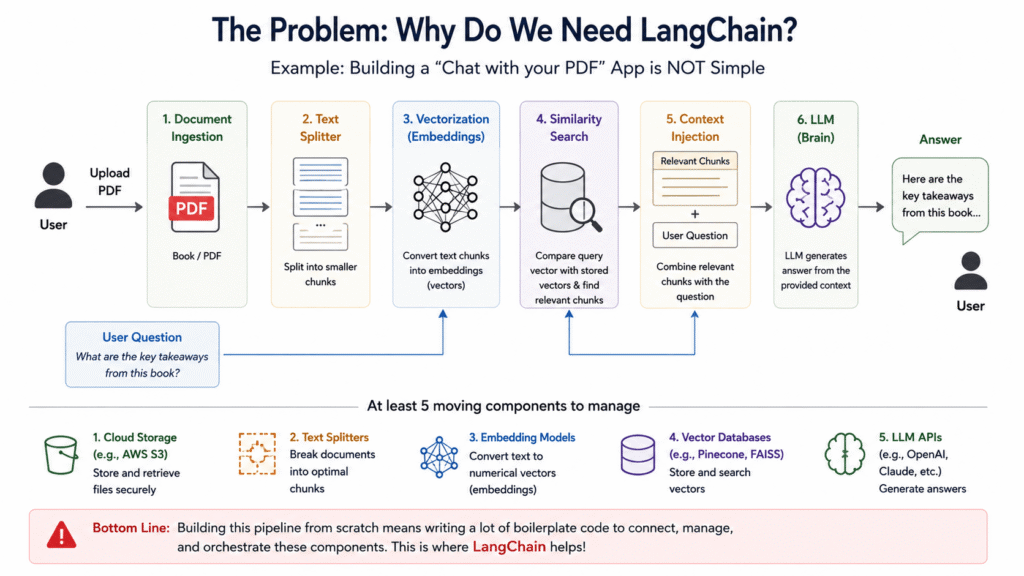
To understand the importance of LangChain, imagine trying to build a “Chat with your PDF” application. On the surface, it sounds simple: upload a book and ask questions. However, the technical execution is complex.
Giving an entire 1,000-page book directly to an LLM is computationally expensive and often results in lower-quality answers. Instead, modern systems use Semantic Search. This involves:
- Vectorization: Converting text into “embeddings” (numerical vectors) that represent the semantic meaning of the words.
- Similarity Search: Comparing a user’s query vector against document vectors to find the most relevant pages.
- Context Injection: Sending only the relevant pages and the query to the LLM (the “Brain”) to generate a precise answer.
Building this pipeline from scratch involves managing at least five moving components: cloud storage (like AWS S3), text splitters, embedding models, vector databases, and LLM APIs. Writing the “boilerplate” code to make these components talk to each other is a massive engineering challenge.
How LangChain Solves the Orchestration Challenge #
LangChain acts as the glue for these components, allowing developers to focus on their core ideas rather than the underlying infrastructure. Its primary benefits include:
- Chains: This is the core concept that gives the framework its name. You can create a “Chain” (a pipeline) where the output of one component automatically becomes the input of the next. You can build parallel, conditional, or highly complex sequences of tasks with ease.
- Model Agnostic Development: LangChain allows you to switch between LLM providers (e.g., moving from OpenAI to Google Gemini) with just a few lines of code, ensuring your application isn’t locked into a single vendor.
- A Complete Ecosystem: It provides built-in interfaces for over 50 types of text splitters, numerous document loaders (PDF, Excel, Cloud), and various vector databases.
- Memory and State Handling: It solves the “forgetfulness” of LLMs by providing conversation memory. This allows the model to remember previous parts of a chat, enabling context-aware follow-up questions.
Real-World Use Cases
LangChain is being used to build a wide variety of tools, including:
- Conversational Chatbots: Helping internet businesses scale customer service by handling the first layer of communication.
- AI Knowledge Assistants: Creating tools that “know” a company’s private data or specific course materials to answer student queries.
- AI Agents: Autonomous systems that can use tools and make decisions to complete complex tasks.
- Summarization and Research Helpers: Tools that can process massive documents and extract key insights without hitting context window limits.
Are There Alternatives? #
While LangChain is highly popular, it is not the only player in the field. Other notable frameworks include:
- LlamaIndex: Particularly strong for data indexing and retrieval.
- Haystack: Another robust framework for building LLM applications.
Conclusion
The “boom” of LLM-based applications is just beginning, much like the early days of websites and mobile apps. LangChain stands at the center of this revolution, providing the necessary orchestration to turn powerful models into functional, complex applications. Whether you are building a simple summarizer or a complex AI agent, LangChain provides the tools to move from idea to execution efficiently.
RAG Fundamentals Quiz #
Q.1 According to the source, what is the primary definition of LangChain?
A programming language used to train foundation models from scratch.
An open-source framework for developing applications powered by LLMs.
A proprietary database designed specifically for storing high-dimensional vectors.
A cloud service provider like AWS or GCP that hosts Large Language Models.
Explanation
LangChain is an open-source framework that helps developers build applications powered by Large Language Models. It provides components for prompts, memory, chains, agents, retrieval, and integrations with multiple LLM providers.
Q.2 In the PDF-to-Chat application design, why is semantic search preferred over keyword search?
It automatically translates the PDF content into multiple languages for better indexing.
It finds results based on the meaning and context of the query rather than exact word matches.
It is computationally faster and requires less memory than keyword matching.
It allows the system to bypass the need for a Large Language Model entirely.
Explanation
Semantic search retrieves information based on meaning rather than exact keyword matches. This enables more accurate and context-aware results, even when different words or phrases are used.
Q.3 What happens when a paragraph is converted into an embedding?
It is converted into a vector, which is a set of numbers representing its semantic meaning.
It is compressed into a smaller, readable summary of the text.
It is encrypted to ensure that the data cannot be read by third-party APIs.
It is split into individual characters to be stored in a traditional relational database.
Explanation
An embedding converts text into a numerical vector that captures its semantic meaning. These vectors allow computers to compare the similarity between different pieces of text efficiently.
Q.4 In the provided system design, what are the two core capabilities required for the Brain component?
Keyword extraction and SQL query generation.
Natural Language Understanding (NLU) and context-aware text generation.
Image recognition and vector database indexing.
Data encryption and cloud storage management.
Explanation
The Brain component must understand the user’s question using Natural Language Understanding (NLU) and generate a relevant, context-aware response using the retrieved information.
Q.5 Why does the author suggest using an LLM API (like OpenAI) instead of hosting a model locally?
APIs allow the application to work without an internet connection.
APIs provide better security than local server environments.
It reduces the massive computational cost and engineering complexity of managing heavy models.
Local hosting removes the need for LangChain orchestration.
Explanation
Using an LLM API eliminates the need to purchase expensive GPUs, manage infrastructure, and maintain large models, allowing developers to focus on building applications instead of managing hardware.
Q.6 What is a major benefit of Model Agnosticism in LangChain?
It automatically optimizes the model's weights for a specific dataset.
It removes the need to use vector embeddings for semantic search.
It ensures that the model never gives incorrect or hallucinated answers.
It allows developers to switch between different LLMs with minimal code changes.
Explanation
Model Agnosticism provides a common interface for different LLM providers. Developers can switch between models like OpenAI, Gemini, or Anthropic with little or no modification to the application code.
Q.7 How does LangChain handle Memory in a conversation?
By limiting the user to only five questions per session to save server space.
By allowing the model to recall previous parts of the conversation to understand context-dependent queries.
By storing the entire PDF in the user's browser cache.
By permanently rewriting the model's weights after every user interaction.
Explanation
LangChain Memory stores previous conversation history so the model can understand references, maintain context, and generate coherent follow-up responses.
Q.8 According to the source, how do AI Agents differ from standard chatbots?
Agents are designed to replace human programmers entirely.
Agents can only communicate in code, while chatbots use natural language.
Agents do not use Large Language Models, whereas chatbots do.
Agents are capable of executing tasks and using tools, such as booking a flight.
Explanation
AI Agents extend the capabilities of chatbots by reasoning, planning, and using external tools or APIs to perform actions such as booking flights, searching the web, or interacting with databases.
Q.9 Which of the following frameworks is mentioned as a popular alternative to LangChain?
LlamaIndex
React.js
OpenAI Studio
TensorFlow
Explanation
LlamaIndex is a popular framework for building Retrieval-Augmented Generation (RAG) applications and is commonly used as an alternative or complement to LangChain.
Q.10 What is the purpose of a Text Splitter in the LangChain workflow?
To separate the images in a PDF from the text content.
To break down large documents into smaller chunks for efficient embedding and retrieval.
To translate text from one language to another before processing.
To identify and remove grammatically incorrect sentences from the PDF.
Explanation
A Text Splitter divides large documents into smaller chunks, making them easier to embed, index, retrieve, and process efficiently in Retrieval-Augmented Generation (RAG) pipelines.


