FastAPI is a modern, high-performance web framework for building APIs with Python, heavily based on standard Python type hints. It was designed from the ground up to be easy to use, fast to code, and production-ready, particularly for applications involving asynchronous I/O operations and data validation. To use FastAPI, you need Python 3.7 or higher.
Key Features #
FastAPI is packed with features that improve both performance and the developer experience:
- High Performance: It is one of the fastest Python frameworks available, offering speeds comparable to Node.js and Go.
- Fast to Code: Developers can increase the speed of feature development by 200% to 300%.
- Reduced Bugs: By leveraging Python type hints, it reduces human-induced errors by approximately 40%.
- Automatic Documentation: One of its most famous features is the built-in integration with Swagger UI (/docs) and ReDoc (/redoc), which automatically generates interactive API documentation.
- Built-in Validation: It uses Pydantic to ensure all incoming data is structured, typed, and clean before it reaches your logic.
- Asynchronous Support: It natively supports
asyncandawait, allowing the server to handle multiple tasks concurrently without blocking.
Why FastAPI? #
FastAPI has become one of the most popular Python backend frameworks because it combines high performance with a clean developer experience. It is widely used for REST APIs, AI/ML model deployment, microservices, authentication systems, and production web applications.
The Architecture: Core Pillars #
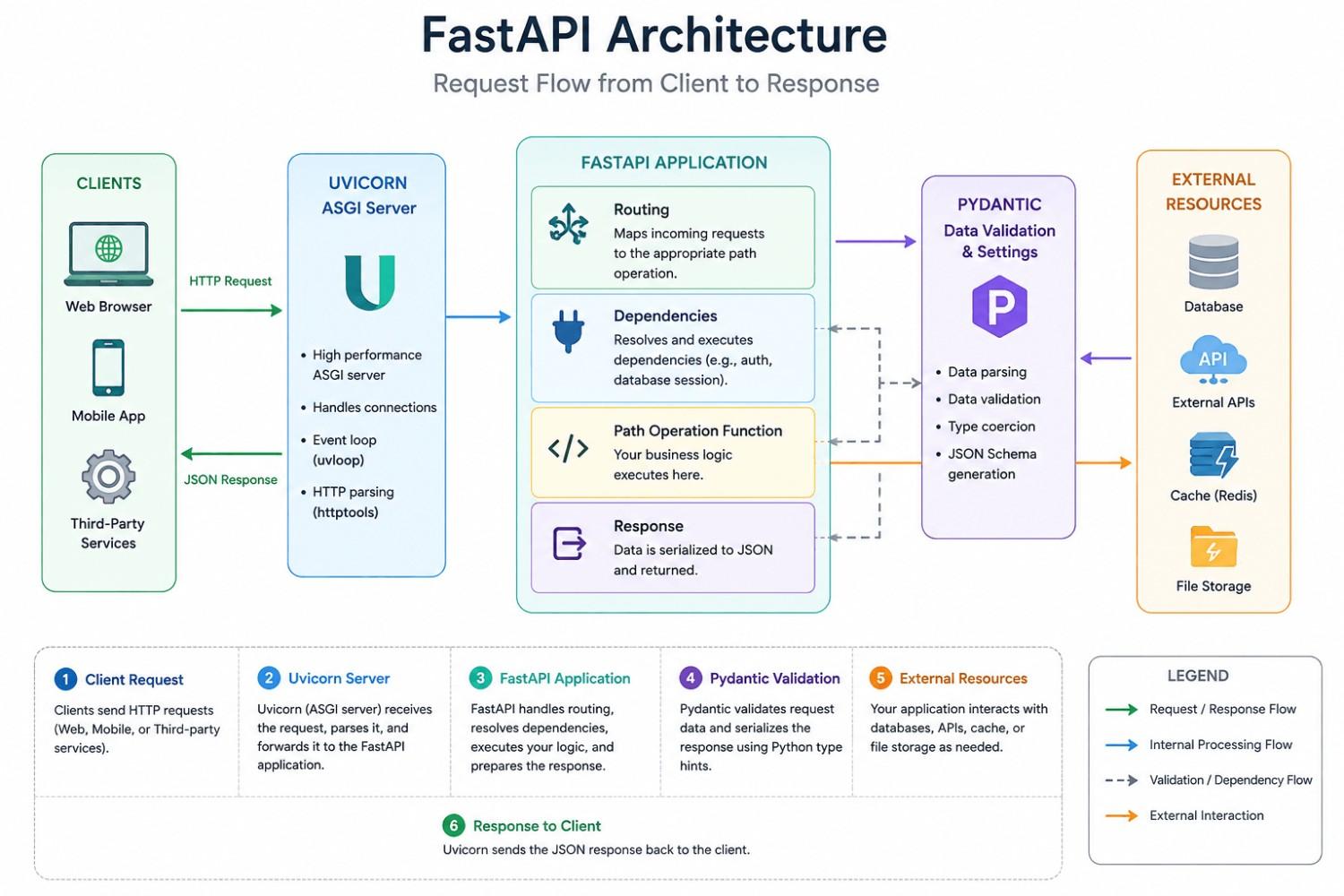
The power of FastAPI comes from its foundation on three essential libraries:
- Starlette: A lightweight ASGI web framework that handles the core web layer, including routing and real-time WebSocket communication.
- Pydantic: A data parsing and validation library that uses type hints to enforce data structures and auto-generate JSON Schemas.
- Uvicorn: A lightning-fast ASGI server implementation (based on
uvloopandhttptools) that serves as the entry point to launch your application and handle client requests.
ASGI (Asynchronous Server Gateway Interface) is the modern successor to WSGI. It enables asynchronous programming, WebSockets, and higher concurrency, making FastAPI suitable for modern web applications.
1. Installation Guide using pip #
This is the standard installation method as described in the sources.
Step 1: Create and Activate a Virtual Environment It is recommended to use a virtual environment to keep your project dependencies isolated.
- On Windows:
- On macOS/Linux:
Setting Up FastAPI Using pip #
Step 1: Create a Virtual Environment #
A virtual environment creates an isolated Python environment for your project, keeping its dependencies separate from other projects.
python -m venv venvHere, venv is the name of the virtual environment. You can replace it with any name (e.g., .venv or myenv).
Step 2: Activate the Virtual Environment #
Activate the virtual environment before installing any packages.
Windows (CMD)
venv\Scripts\activateWindows (PowerShell)
venv\Scripts\Activate.ps1Linux/macOS
source venv/bin/activateAfter activation, your terminal prompt will display
(venv).
Step 3: Install FastAPI #
Install FastAPI and the Uvicorn ASGI server.
pip install fastapi uvicornor install the recommended package with additional development dependencies: pip install “fastapi[standard]”
Step 4: Run the FastAPI Application #
Start the development server using:
from fastapi import FastAPI
app=FastAPI()

@app.get('/')
def index():
    return {'message':'Hello,Fast API'}
uvicorn main:app --reloadExplanation:
main→ Name of the Python file (main.py).app→ The FastAPI application object (app = FastAPI()).--reload→ Automatically restarts the server whenever you save changes to the code (development mode).
Once the server starts successfully, open:
- http://127.0.0.1:8000/ → API endpoint
- http://127.0.0.1:8000/docs → Interactive Swagger UI
- http://127.0.0.1:8000/redoc → ReDoc API documentation
Installing FastAPI Using uv #
Step 1: Install uv #
Install the uv package manager.
pip install uvVerify the installation:
uv --versionStep 2: Create a Virtual Environment #
Create an isolated virtual environment for your project.
uv venvThis creates a .venv folder in your project.
Step 3: Activate the Virtual Environment #
Windows (CMD)
.venv\Scripts\activateWindows (PowerShell)
.venv\Scripts\Activate.ps1Linux/macOS
source .venv/bin/activateStep 4: Install FastAPI #
Install FastAPI and its recommended dependencies.
uv pip install "fastapi[standard]"or
uv pip install fastapi uvicornStep 5: Run the FastAPI Application #
Start the development server.
from fastapi import FastAPI
app=FastAPI()

@app.get('/')
def index():
    return {'message':'Hello,Fast API'}
Run Code Use Command: uvicorn main:app --reloadExplanation:
main→ Python file (main.py)app→ FastAPI application object (app = FastAPI())--reload→ Automatically reloads the server whenever the source code changes.
Once the server starts, open:
- http://127.0.0.1:8000/ → API endpoint
- http://127.0.0.1:8000/docs → Swagger UI
- http://127.0.0.1:8000/redoc → ReDoc documentation
3. Comparison: uv vs. pip.
| Feature | pip | uv |
|---|---|---|
| Speed | Standard speed; can be slower for large dependency trees. | Extremely fast; written in Rust for high performance. |
| Dependency Resolution | Standard dependency resolution. | Highly optimized and significantly faster dependency resolver. |
| Virtual Environment | Requires Python’s built-in venv module. | Built-in support with uv venv. |
| Package Installation | pip install package | uv pip install package (much faster). |
| Python Installation | Cannot install Python versions. | Can install and manage Python versions (uv python install). |
| Dependency Sync | Uses requirements.txt; manual synchronization. | Supports fast dependency synchronization with uv sync. |
| Lock Files | No native lock file support. | Supports reproducible environments using uv.lock. |
| Caching | Uses a global cache but often reinstalls packages. | Shared global cache avoids unnecessary downloads and reinstalls. |
| All-in-One Tool | Primarily a package installer; uses separate tools for virtual environments and dependency management. | Combines package management, virtual environments, dependency resolution, and Python management in one tool. |
| Disk Space Usage | May duplicate packages across environments. | Efficient shared cache reduces disk usage. |
| Cold Installation | Slower on first install. | Much faster even for fresh installations. |
| Repeat Installation | May reinstall packages in each environment. | Reuses cached packages, making repeat installs very fast. |
| Compatibility | Supported by virtually all Python projects. | Fully compatible with existing pip workflows and packages. |
| Cross-Platform | Windows, Linux, macOS. | Windows, Linux, macOS. |
| Learning Curve | Familiar to most Python developers. | Very similar to pip; easy transition. |
| Performance on Large Projects | Slower as dependency count grows. | Optimized for projects with many dependencies. |
| Best Use Case | Existing Python projects and legacy workflows. | New Python projects, modern development, and CI/CD pipelines. |
Conclusion #
FastAPI is one of the best Python frameworks for building modern APIs. With automatic validation, interactive documentation, asynchronous support, and excellent performance, it is an excellent choice for beginners and experienced developers alike. Whether you install it using pip or the faster uv package manager, you’ll have a solid foundation for building production-ready REST APIs.
FastAPI Quiz #
Q.1 What is FastAPI?
A Python library for data analysis
A modern, high-performance web framework for building APIs
A JavaScript frontend framework
A relational database management system
Explanation
FastAPI is a modern, high-performance Python web framework specifically designed for building RESTful APIs. It emphasizes speed, simplicity, and automatic data validation using Python type hints.
Q.2 FastAPI is primarily built for developing __.
Desktop applications
Mobile applications
REST APIs and web services
Game engines
Explanation
FastAPI is mainly used to develop REST APIs and backend web services. It provides features like routing, request validation, dependency injection, and automatic API documentation.
Q.3 Which Python feature does FastAPI heavily rely on for data validation?
Decorators
Generators
Type Hints
Lambda Functions
Explanation
FastAPI uses standard Python type hints to validate request data, generate API documentation, and improve developer productivity.
Q.4 Which library is responsible for data validation in FastAPI?
NumPy
Pydantic
Pandas
SQLAlchemy
Explanation
Pydantic is used by FastAPI for parsing, validating, and serializing data. It ensures that incoming requests match the expected schema.
Q.5 Which library provides the underlying ASGI framework for FastAPI?
Flask
Django
Starlette
Bottle
Explanation
FastAPI is built on top of Starlette, which provides the high-performance ASGI framework responsible for routing, middleware, WebSockets, and asynchronous request handling.
Q.6 Which ASGI server is commonly used to run FastAPI applications?
Apache
Nginx
Uvicorn
Gunicorn
Explanation
Uvicorn is the recommended ASGI server for FastAPI. It handles incoming HTTP requests and efficiently serves asynchronous Python applications.
Q.7 Which feature allows FastAPI to automatically generate interactive API documentation?
Pydantic Models
Swagger UI and ReDoc
Jinja2 Templates
SQLAlchemy ORM
Explanation
FastAPI automatically generates interactive API documentation using Swagger UI (/docs) and ReDoc (/redoc), making it easy to test and explore APIs.
Q.8 What is one major advantage of FastAPI's support for async and await?
Reduces code size
Improves concurrent request handling
Removes the need for databases
Automatically creates frontend pages
Explanation
FastAPI’s native support for async and await enables non-blocking I/O operations, allowing the server to handle many requests concurrently and improving performance.
Q.9 What is the minimum recommended Python version required to use FastAPI?
Python 2.7
Python 3.5
Python 3.7
Python 3.6
Explanation
FastAPI requires Python 3.7 or later because it depends on modern language features such as type annotations and asynchronous programming support.
Q.10 Which statement best describes FastAPI?
A frontend JavaScript framework for building user interfaces
A Python framework focused on building fast, production-ready APIs with automatic validation and documentation
A database engine for storing application data
A package manager for Python
Explanation
FastAPI is a modern Python web framework designed to build high-performance, production-ready APIs. It combines automatic data validation, asynchronous programming, dependency injection, and interactive API documentation into a developer-friendly framework.


