PyTorch is an open-source deep learning library developed by Meta AI (formerly Facebook AI Research) that has fundamentally transformed the landscape of artificial intelligence and machine learning. It combines the simple, intuitive nature of Python programming with the high-performance computational power of the original Torch framework. Today, it stands as a favorite among both researchers and industry professionals due to its flexibility and robust community support.
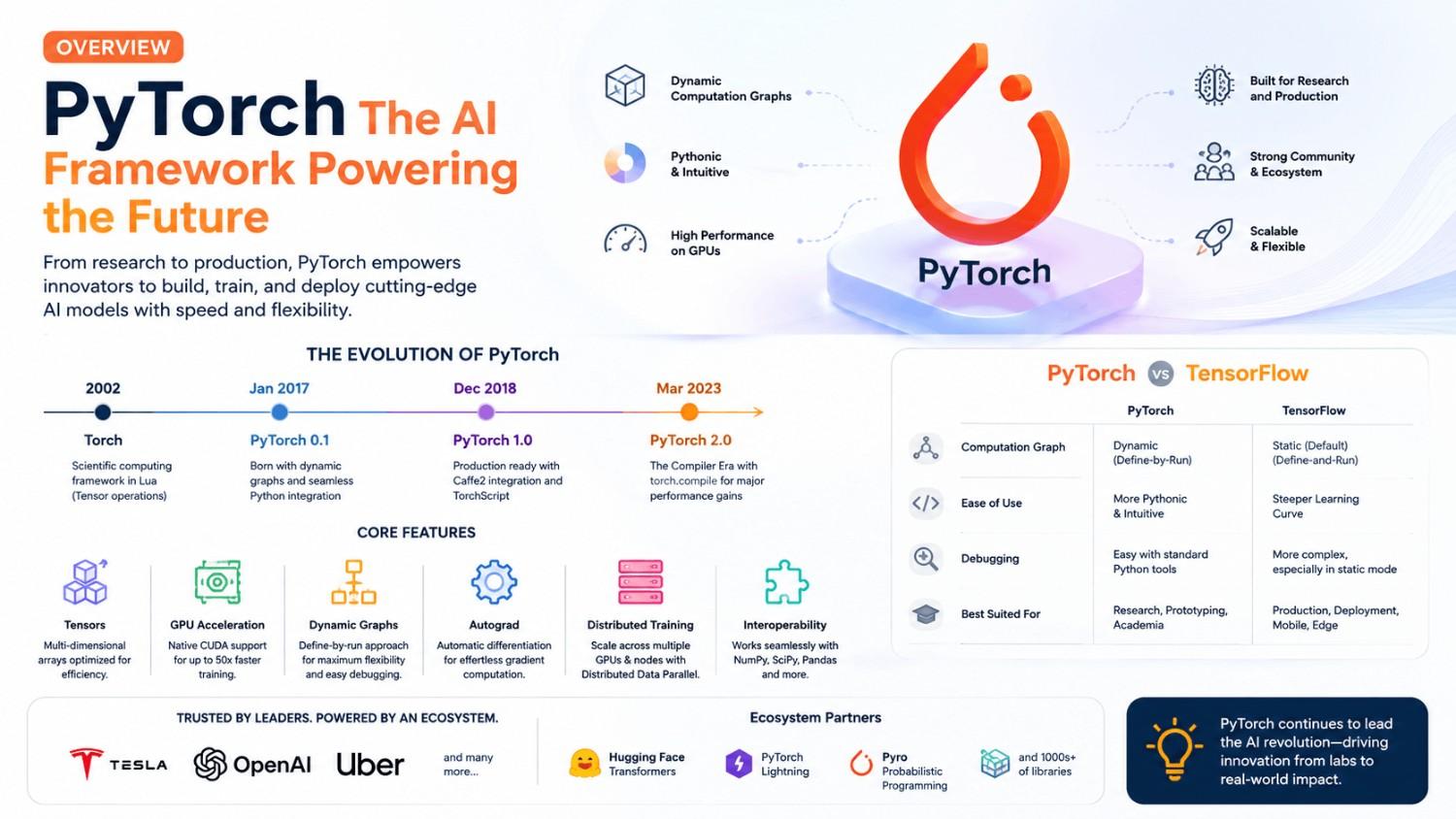
The Evolution of PyTorch: From Lua to the Compiler Era #
The journey of PyTorch began with Torch, a scientific computing framework built in 2002 that excelled in tensor operations but was written in the Lua programming language.
Because Lua was not widely used, Meta AI researchers recognized the need to merge Torch’s power with the accessibility of Python. This effort resulted in the release of PyTorch 0.1 in January 2017, which introduced dynamic computation graphs and seamless integration with the Python ecosystem.
In December 2018, PyTorch 1.0 was released to bridge the gap between experimental research and production-grade deployment.
This version integrated Caffe2 for enhanced performance and introduced TorchScript, a tool for model serialization that allowed models to run in environments without a Python interpreter. The most recent major milestone, PyTorch 2.0 (released in March 2023), ushered in the “Compiler Era”.
This version introduced the torch.compile function, which optimizes model execution to provide significant performance boosts on modern hardware like GPUs and TPUs.
Core Features of PyTorch #
PyTorch’s popularity is built on several key technical strengths:
- Tensor Computations: At its core, PyTorch uses tensors, which are multi-dimensional arrays optimized for mathematical efficiency and hardware acceleration.
- GPU Acceleration: PyTorch provides native support for NVIDIA GPUs via CUDA, enabling training and inference speeds up to 50 times faster than a standard CPU.
- Dynamic Computation Graph (Define-by-Run): Unlike frameworks that use static graphs, PyTorch builds its computation graph during runtime. This “define-by-run” approach allows for flexible model architectures, including those with loops and conditionals, and makes debugging much more intuitive.
- Automatic Differentiation (Autograd): The Autograd engine is the library’s automatic differentiation system that computes gradients automatically during the backward pass, eliminating the need for manual derivative calculations.
- Distributed Training: As models grow in size, PyTorch enables distributed data parallelism (DDP) to scale training across multiple GPUs and nodes efficiently.
- Seamless Interoperability: PyTorch is designed to work harmoniously with other Python libraries like NumPy, SciPy, and Pandas, allowing users to integrate it easily into existing workflows.
The Future of AI and the PyTorch Ecosystem #
PyTorch is currently the de facto deep learning library for building modern AI applications, particularly in the realm of Generative AI and Large Language Models (LLMs). Its ecosystem has expanded to include powerful third-party libraries such as Hugging Face Transformers, which hosts thousands of pre-trained models, and PyTorch Lightning, which simplifies complex training loops.
The framework is trusted by some of the world’s leading technology companies and research institutions. Tesla utilizes PyTorch for its Autopilot computer vision systems, OpenAI uses it to train its advanced GPT models, and Uber built its probabilistic programming language, Pyro, on top of it. As the field moves toward more complex, data-intensive tasks, PyTorch’s commitment to hardware optimization and research flexibility ensures it will remain a cornerstone of AI innovation for years to come.
What are the biggest differences between PyTorch and TensorFlow? #
The biggest differences between PyTorch and TensorFlow stem from their core philosophies, how they handle computation graphs, and their primary areas of application. While both frameworks are converging in terms of features, the following points highlight their distinct characteristics:
1. Computation Graphs (The Core Technical Difference)
- PyTorch (Dynamic/Define-by-Run): PyTorch builds its computation graph during runtime. This allows for incredible flexibility, enabling you to use standard Python control flow like loops and conditionals within your model definition.
- TensorFlow (Static/Define-and-Run): TensorFlow traditionally used static graphs, where the graph is defined and optimized before execution begins. While TensorFlow 2.x introduced “Eager Execution” to mimic dynamic behavior, it remains static by default in many production contexts.
2. Ease of Use and Debugging
- PyTorch: Frequently described as more “Pythonic” and intuitive. Because the graph is built step-by-step at runtime, you can use standard Python debugging tools (like
pdb) to inspect your code, making the debugging process much simpler. - TensorFlow: Historically has a steeper learning curve and can be more complex to master. Debugging can be more challenging, especially in static mode, as errors may not surface until the entire graph is executed.
3. Research vs. Industry Focus
- PyTorch: Has become the favorite in academia and research. Its flexibility makes it ideal for rapid prototyping and experimenting with novel neural network architectures.
- TensorFlow: Was designed from the start with industry and production deployment in mind. It offers a more mature suite of tools for serving models at scale, such as TensorFlow Serving, TensorFlow Lite (for mobile), and tensorflow.js.
4. Ecosystem and Deployment
- Deployment Tools: TensorFlow currently holds the lead in production deployment with mature libraries like TFX (TensorFlow Extended). PyTorch has been closing this gap with the introduction of TorchScript, which allows models to be serialized and run in environments without a Python interpreter.
- Language Support: TensorFlow supports a wider range of languages, including JavaScript, Java, Go, and Swift. PyTorch is primarily Python-centric, though it provides a C++ frontend called LibTorch.
5. Interoperability
- PyTorch: Offers seamless integration with the Python scientific ecosystem (NumPy, SciPy, Pandas). Tensors can be easily converted to and from NumPy arrays.
- TensorFlow: While it has high interoperability, its tensors are not always directly compatible with NumPy without explicit conversion.
| Feature | PyTorch | TensorFlow |
|---|---|---|
| Graph Type | Dynamic (Define-by-Run) | Static (Define-and-Run) |
| Learning Curve | Gentle / Intuitive | Steeper / Complex |
| Primary Domain | Research & Academia | Industry & Production |
| Debugging | Easy (Standard Python tools) | More complex |
| Deployment | Growing (TorchScript) | Mature (TF Serving, TF Lite) |
What is the difference between static and dynamic computation graphs? #
A computation graph is a visual way of representing mathematical operations, where each node in the graph represents a specific calculation. Deep learning libraries use these graphs internally to store and execute the operations required for neural networks.
The primary difference between static and dynamic computation graphs lies in when the graph is constructed and how much flexibility it allows during execution.
Static Computation Graphs (Define-and-Run)
Traditionally used by frameworks like early TensorFlow and the original Torch, static graphs follow a “define-and-run” philosophy.
- Construction Time: The entire structure of the graph is defined and compiled before any data is processed.
- Flexibility: Once built, the graph is fixed and cannot be changed during training. This makes it less flexible for experimenting with novel architectures.
- Performance: Because the structure is known ahead of time, compilers can perform aggressive optimizations, which can lead to higher performance in production environments.
- Debugging: Errors often don’t surface until the entire graph is executed, making debugging more difficult.
Dynamic Computation Graphs (Define-by-Run)
Introduced by PyTorch, dynamic graphs follow a “define-by-run” philosophy.
- Construction Time: The graph is built on-the-fly during runtime as the code is executed.
- Flexibility: The graph can change at runtime based on input data. This allows for the direct use of standard Python control flow, such as loops and conditionals, within the model.
- Performance: Historically, dynamic graphs faced a slight performance hit because they change during execution, though modern versions of PyTorch have significantly optimized this.
- Debugging: Since the graph is built step-by-step, it is much more intuitive and easier to debug using standard Python tools.
The Road Map Analogy
The sources provide a helpful analogy to explain the difference:
- Static is like a finalized road map for a project. If you discover an obstacle (like a temple) while building the road, you cannot change the path because the plan is fixed.
- Dynamic is like having the flexibility to adjust the route on-the-go. If an obstacle appears, you can simply change the road’s path during construction.
| Feature | Dynamic (PyTorch) | Static (Others/Early TensorFlow) |
|---|---|---|
| Philosophy | Define-by-Run | Define-and-Run |
| Construction | Built at Runtime | Built at Compile-time |
| Control Flow | Uses standard Python loops/if-statements | Requires specialized symbolic APIs |
| Debugging | Easy (built incrementally) | Difficult (fixed structure) |
| Optimization | Harder to optimize globally | High potential for optimization |
Which industry leaders are currently using PyTorch for their products? #
Meta (Facebook): As the creator and primary maintainer, Meta uses PyTorch for AI applications across all its platforms.- Tesla: The entire Autopilot system for Tesla’s autonomous vehicles is written in PyTorch, specifically for computer vision-related tasks.
- OpenAI: This leading AI research firm uses PyTorch to train its advanced GPT (Generative Pre-trained Transformer) models.
- Microsoft: PyTorch is extensively used in Azure Machine Learning services. Microsoft also co-developed the ONNX (Open Neural Network Exchange) format with Meta to ensure model interoperability.
- Amazon: Through Amazon SageMaker, AWS provides managed environments for PyTorch and uses it for internal research and AI services.
- NVIDIA: They collaborate directly with the PyTorch team to optimize the framework for GPU computing and hardware acceleration.
- Google: While Google created TensorFlow, organizations under its umbrella like Google Brain and DeepMind utilize PyTorch for various research papers and experimental projects.
- IBM: PyTorch is integrated into IBM Watson and various IBM Cloud AI solutions.
Automotive and Transportation
- Uber: Beyond perception models for its self-driving research (Uber ATG), Uber uses PyTorch for demand forecasting and route optimization. They even built Pyro, a probabilistic programming language, on top of PyTorch.
- Lyft: Uses PyTorch to develop machine learning models for its self-driving car division, Level 5.
- Toyota: The Toyota Research Institute employs PyTorch for AI research in robotics and automation.
Healthcare and Finance
- Healthcare: Philips Healthcare and Siemens Healthineers use PyTorch for medical imaging, diagnostics, and developing healthcare-specific AI applications.
- Finance: JPMorgan Chase and Goldman Sachs utilize the framework for risk modeling, fraud detection, trading algorithms, and predictive analytics.
Retail, E-commerce, and Other Sectors
- Retail: Alibaba uses it for large-scale recommendation systems and search optimization, while Shopify uses it for merchant analytics and demand forecasting.
- Fashion: Zalando built its visual search models and fashion recommendation systems using PyTorch.
- Space and Research: NASA uses PyTorch for processing space exploration data and satellite image analysis.
- Non-Profit: UNICEF and the National Institutes of Health (NIH) use it for humanitarian aid analytics and medical research, respectively.
PyTorch Quiz #
Q.1 What primary friction point in the original Torch framework led Meta AI researchers to develop PyTorch?
The framework was built using the Lua programming language.
The framework lacked support for GPU acceleration.
It was incompatible with neural network architectures.
It could only handle one-dimensional arrays.
Explanation
The original Torch framework was based on Lua, which was less widely adopted than Python. PyTorch was developed to provide a Python-first deep learning framework while retaining Torch’s strengths.
Q.2 How does a dynamic computation graph, as used in PyTorch, differ from the static graphs traditionally found in other frameworks?
It is built on-the-fly during runtime, allowing for flexible model architectures.
It is defined and optimized entirely before program execution begins.
It requires the model structure to be finalized before the forward pass.
It prevents the use of standard Python debugging tools like pdb.
Explanation
PyTorch builds the computation graph dynamically during runtime, making it easy to modify models, debug code, and implement architectures with variable control flow.
Q.3 What was the strategic purpose of merging PyTorch with Caffe2 during the version 1.0 release in 2018?
To replace Python with a more efficient C++ frontend for research.
To bridge the gap between research flexibility and production-grade deployment.
To limit the library's compatibility to only NVIDIA hardware.
To introduce the first implementation of tensors to the ecosystem.
Explanation
PyTorch 1.0 combined the research-friendly flexibility of PyTorch with the production deployment capabilities of Caffe2, enabling a unified framework for both research and production.
Q.4 Within the PyTorch core modules, which specific module is responsible for the 'Automatic Differentiation' required for backpropagation?
torch.utils.data
torch.nn
torch.autograd
torch.optim
Explanation
The torch.autograd module automatically computes gradients during backpropagation, enabling efficient optimization of neural network parameters.
Q.5 In the context of model optimization, what is the primary function of 'Quantization' in PyTorch?
To allow a single model to be trained across multiple GPU clusters.
To visualize the computation graph using external tools like TensorBoard.
To reduce model size and increase inference speed by using lower-precision arithmetic.
To increase the numerical precision of weights from 16-bit to 64-bit.
Explanation
Quantization converts model weights and activations to lower-precision formats, such as INT8, reducing memory usage and improving inference speed with minimal accuracy loss.
Q.6 PyTorch 2.0, released in 2023, is often described as the beginning of the 'Compiler Era.' Which function is central to this shift?
torch.save()
torch.cuda.is_available()
torch.compile()
torch.from_numpy()
Explanation
The torch.compile() function automatically optimizes PyTorch models for improved performance by compiling and optimizing computation graphs.
Q.7 Which company uses PyTorch's computer vision capabilities to power its 'Autopilot' system for autonomous driving?
Tesla
OpenAI
Microsoft
Uber
Explanation
Tesla uses PyTorch extensively for developing and training deep learning models that support computer vision tasks in its Autopilot and Full Self-Driving systems.
Q.8 When comparing PyTorch and TensorFlow, what is a notable advantage of TensorFlow in industrial settings?
It provides a more mature ecosystem for production deployment, such as TFX and TF Serving.
It has a more intuitive, Pythonic syntax for beginners.
It lacks any high-level APIs like Keras.
It exclusively uses dynamic computation graphs for all versions.
Explanation
TensorFlow offers a mature production ecosystem, including TensorFlow Extended (TFX), TensorFlow Serving, and TensorFlow Lite, making it a strong choice for enterprise deployment.
Q.9 What is the function of the 'TorchScript' component introduced in PyTorch 1.0?
To replace the need for GPUs by optimizing CPU-only training.
To automatically convert image data into text format for NLP tasks.
To provide a graphical user interface for dragging and dropping neural network layers.
To allow models to run in environments where a Python interpreter is not available.
Explanation
TorchScript converts PyTorch models into a serialized intermediate representation that can run independently of Python, enabling deployment in C++ applications, mobile devices, and production environments.
Q.10 Which domain-specific PyTorch library should be used if you are working on a task involving text classification and translation?
torchaudio
torchvision
torchtext
torch.nn
Explanation
torchtext provides datasets, tokenization utilities, vocabularies, and preprocessing tools specifically designed for natural language processing tasks such as text classification, translation, and language modeling.


