Artificial intelligence is rapidly moving from research labs into everyday business operations. What once seemed experimental is now becoming part of office software, customer support systems, data analysis platforms, and software development workflows.
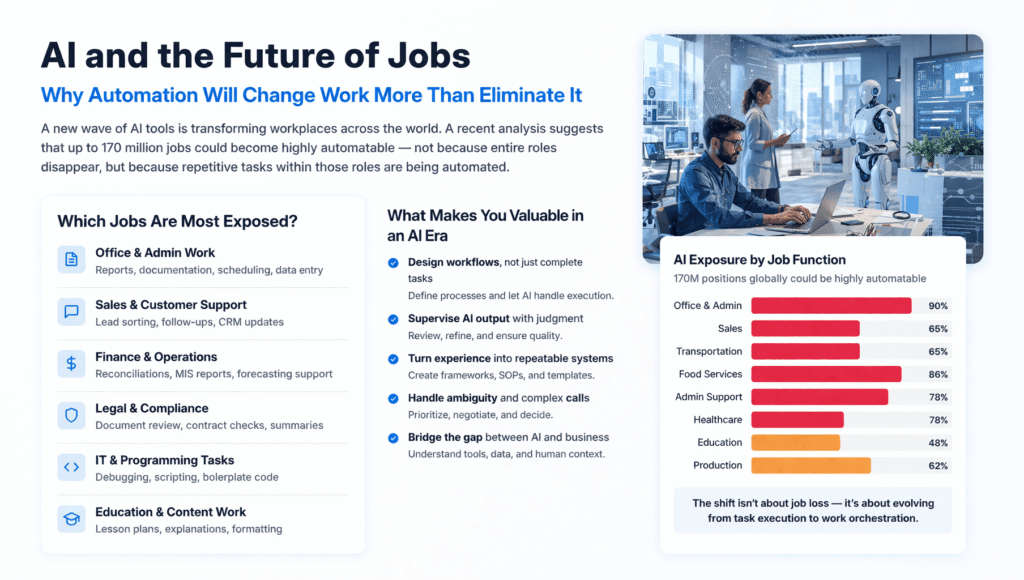
A recent industry discussion highlighted a major prediction: nearly 170 million positions worldwide may become highly automatable as AI systems improve.
At first glance, this sounds alarming.
Many people immediately think that jobs will disappear completely. Others assume such estimates are exaggerated.
The reality is more practical: AI usually transforms tasks before it transforms full professions.
A role is rarely removed in one step. Instead, repetitive parts of that role begin shifting toward automated systems.
Which Jobs Are Most Exposed to AI?
The strongest impact is visible in work that depends heavily on structured information.
The chart shows that sectors with high exposure include:
- Office administration
- Sales support
- Business and finance operations
- Legal documentation
- Computer-related analytical work
- Educational content preparation
These professions share common characteristics:
- repeated digital workflows
- document-heavy activity
- fixed decision rules
- pattern-based processing
- frequent summarization of information
That is exactly where AI performs efficiently.
Physical work, unpredictable field tasks, and human-sensitive services still remain harder to automate fully.
Why Office and Knowledge Work Face Higher Automation
In many office environments, daily work follows repeatable sequences:
- preparing reports
- formatting documents
- replying to standard communication
- reviewing data
- organizing records
AI tools can now handle large portions of these activities faster than before.
For example:
A finance analyst may still make final decisions, but AI can already prepare initial reports.
A programmer may still design architecture, but AI can draft repeated code blocks.
A legal professional may still apply judgment, but document scanning can now be automated.
So the profession remains — but its internal work changes.
What Keeps Professionals Valuable in the AI Era?
The people gaining the most advantage today are not competing directly with AI.
They are learning how to work above it.
1. Designing complete workflows
Instead of only doing individual tasks, strong professionals define how work should move from start to finish.
2. Supervising AI-generated output
AI can produce drafts quickly, but humans must verify quality, relevance, and correctness.
3. Turning expertise into systems
Those who build frameworks, checklists, and repeatable methods become more valuable because systems can scale.
4. Solving unclear problems
Negotiation, prioritization, strategic thinking, and trade-offs still require human judgment.
5. Connecting business needs with machine capability
The future belongs to people who understand both operational goals and AI tools.
The Real Shift: Execution to Orchestration
A major workplace transition is happening:
Manual execution is decreasing. System orchestration is increasing.
This means companies increasingly value people who can:
- choose the right tools
- guide outputs
- improve processes
- manage exceptions
- make final decisions
The employee who understands systems often creates more impact than the employee who only completes repeated tasks.
Should Professionals Be Worried?
Concern is natural, but adaptation is more useful than fear.
The strongest response is skill expansion.
For students and professionals, this means learning:
- AI tools
- data thinking
- automation logic
- communication
- decision-making frameworks
Especially for technology students, combining domain knowledge with AI literacy creates a strong advantage.
Join For More Updates
| 1. Official Telegram | Click Here |
| 2. Download Our App | Click Here |
| 3. Download Study Routine App | Click Here |
| 4. CS/IT Job Alert | Click Here |
| 5. DRDO & ISRO Job Alert | Click Here |
| 6. EXAM PYQ PDF | Click Here |
| 7. Placement CS\IT | Click Here |