The AI industry is moving into a new phase. Instead of focusing only on bigger language models, companies are now competing on AI agents, autonomous workflows, 3D generation, content identification, speed, and inference costs.
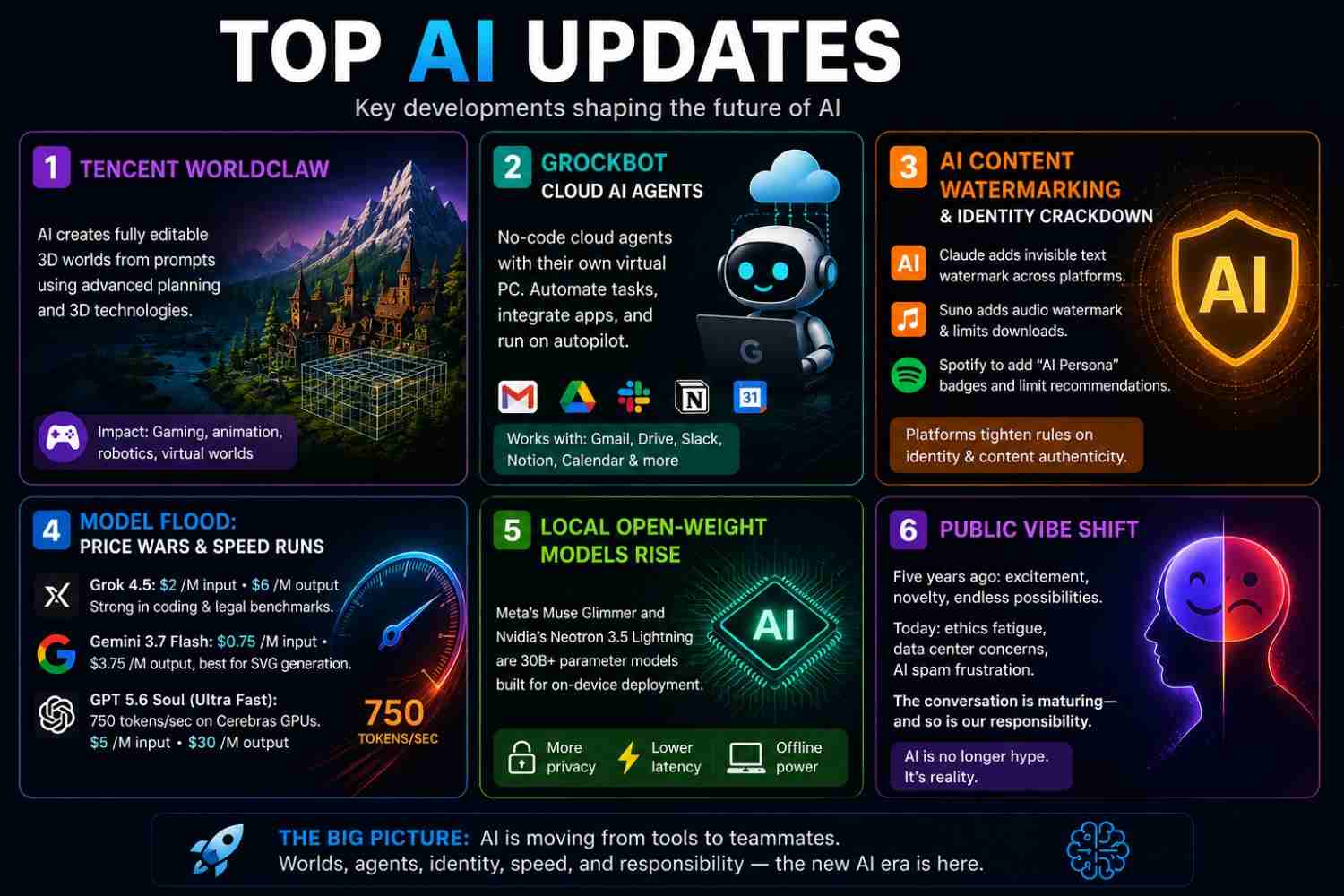
This week’s AI news highlights that shift clearly — from Tencent’s WorldClaw and cloud-based AI agents to invisible AI watermarks, Spotify’s AI artist labels, and the growing competition between models such as Grok, GPT and Gemini.
Here are the biggest developments you should know.
1. Tencent WorldClaw: AI-Generated 3D Worlds
One of the most interesting developments is WorldClaw, Tencent’s research project for generating large 3D environments with AI.
Traditional 3D generation usually focuses on creating a single object — for example, a car, building, tree, or character.
WorldClaw takes a different approach.
The goal is to generate an entire 3D world from a high-level prompt.
An AI planning system can determine the structure of an environment and place different assets within it. This makes the technology potentially useful for creating game environments, virtual worlds, simulations, and robotic training environments.
The important part is that the generated environment is not simply one static image. Individual elements can be treated as separate assets.
That could make AI-generated worlds much more useful for developers.
Why it matters
Imagine a game developer typing:
“Create a large medieval village surrounded by forests, mountains and a river.”
Instead of manually modelling every environment element, AI could generate an initial world that the developer can then modify.
This could significantly reduce the time required for level design and 3D environment creation.
WorldClaw therefore represents a broader trend:
AI is moving from generating content to generating complete environments.
2. AI Agents Are Moving Beyond Chatbots
Another major trend is the growth of autonomous AI agents.
A normal chatbot waits for your question and gives you an answer.
An AI agent can take a goal and perform multiple actions to achieve it.
For example:
User:
“Research five competitors and create a comparison.”
An agent could:
- Search the web.
- Collect information.
- Compare the companies.
- Organize the findings.
- Create a report.
The developer doesn’t necessarily need to control every individual step.
This is why platforms such as Cursor are increasingly focused on long-running coding agents and autonomous workflows.
Instead of simply asking AI to write one function, developers can give an agent a larger objective such as:
“Find the bug, fix it, run the tests and explain the changes.”
The agent can then reason through several steps and use development tools along the way.
The next stage of AI
The evolution is becoming:
Chatbot → Copilot → Agent → Autonomous Workflow
This is one of the most important trends for developers to understand in 2026.
3. Claude and the Rise of AI Content Watermarking
AI-generated content is becoming increasingly difficult to distinguish from human-created content.
That has created a major demand for AI content provenance and watermarking.
Anthropic has announced invisible watermarking for Claude-generated text. The watermark is designed to be imperceptible to users while remaining detectable by specialized systems.
This means that AI-generated text could potentially carry a hidden signal even when it is copied or slightly modified.
The technology is particularly interesting because text watermarking is much harder than watermarking images.
Why does AI watermarking matter?
Consider an article written using AI.
Without provenance technology, a platform may have difficulty determining whether it was:
- Written entirely by a human
- Generated by AI
- Edited using AI
- Translated using AI
- Heavily rewritten by AI
Watermarking and provenance systems could provide additional signals.
This could become important for:
- Education
- Journalism
- Publishing
- Online platforms
- Government
- AI safety
However, it also creates an ongoing debate about privacy, ownership and user control.
The industry is therefore moving toward a future where AI doesn’t just generate content.
It may also attach information about where that content came from.
Source support.claude.com/en/articles/16266773-how-claude-marks-ai-generated-content
4. Spotify and the AI Music Problem
AI-generated music is creating another major challenge for streaming platforms.
Anyone can now use AI tools to create songs, vocals and even complete artist identities.
That raises an important question:
How should streaming platforms identify AI-generated artists?
Spotify is introducing an AI Persona label for certain AI-generated or AI-presented artist profiles.
The idea is to provide listeners with more transparency about what they are hearing.
This doesn’t necessarily mean that every song created with an AI tool will simply be classified as “AI music.”
The bigger issue is the growing use of completely synthetic artist identities.
Why this matters
Imagine an artist profile with:
- AI-generated photographs
- AI-generated vocals
- AI-generated songs
- AI-generated biography
A listener may reasonably assume that the artist is a real human performer.
AI labels could help platforms provide more transparency.
This is another example of the wider trend toward AI identity and content provenance.
Source :suno.com/blog/building-the-future-of-music-responsibly
5. AI Model Price Wars Are Heating Up
The AI competition is no longer only about benchmark scores.
Price and speed are becoming just as important.
Models such as Grok, GPT and Gemini are competing for developers who need to run AI applications at scale.
For an AI application processing millions or billions of tokens, even a small reduction in token cost can produce significant savings.
Developers are therefore comparing models using several factors:
| Factor | Why It Matters |
|---|---|
| Intelligence | Better answers and reasoning |
| Price | Lower production costs |
| Speed | Faster applications |
| Context | Ability to handle large inputs |
| Tool use | Better AI agents |
| Reliability | Fewer failed workflows |
This is particularly important for AI agents.
An agent may call a model many times during one task.
For example:
If every step becomes faster and cheaper, the overall agent becomes much more practical.
6. Faster AI Is Becoming a Competitive Advantage
Model intelligence is important, but latency is becoming another major battleground.
Fast inference can make AI applications feel almost instantaneous.
This is especially useful for:
- Coding assistants
- Voice applications
- Customer support
- Real-time agents
- Interactive AI applications
Hardware companies such as Cerebras are also pushing extremely high inference speeds.
This creates an interesting future:
Better models + faster hardware = real-time AI agents
Instead of waiting several seconds for an AI response, users may eventually interact with AI systems almost like normal software.
7. Gemini, GPT and Grok: Developers Have More Choices
The AI model ecosystem is becoming increasingly competitive.
Developers no longer have to depend on a single model provider.
They can choose between different models depending on their requirements.
For example:
Use a powerful reasoning model when:
- The task is complex.
- Accuracy is critical.
- The agent needs deep reasoning.
Use a fast model when:
- Millions of requests are processed.
- Latency matters.
- The task is simple.
Use a local open-weight model when:
- Privacy is important.
- Internet access is limited.
- You want more control over the model.
This means that model selection is becoming an important engineering skill.
The best AI developer will not necessarily use the most expensive model.
They will know which model to use for which task.
8. Local Open-Weight Models Are Still Growing
Cloud AI gets most of the attention, but local models remain important.
Open-weight models allow developers to run AI on their own infrastructure or hardware.
This provides several advantages:
- Better data control
- Lower long-term inference costs
- Offline capability
- Customization
- Greater deployment flexibility
For companies dealing with sensitive information, local AI can be especially attractive.
This is why the future of AI is unlikely to be completely cloud-based.
Instead, we are likely to see a combination of:
Cloud AI + Local AI + Edge AI
Each will be useful for different workloads.
9. The Public Attitude Toward AI Is Changing
Perhaps the biggest change isn’t technical.
It is the public conversation around AI.
A few years ago, most AI news focused on exciting demonstrations:
“AI can generate an image!”
“AI can write code!”
“AI can create music!”
Now the conversation has become more complicated.
People are discussing:
- AI-generated spam
- Deepfakes
- Copyright
- Job displacement
- Data-center energy consumption
- AI-generated music
- Content authenticity
- Privacy
- Regulation
The novelty phase is gradually ending.
AI is becoming infrastructure.
And once a technology becomes infrastructure, society starts asking harder questions about how it should be used.
Join For More Updates
| 1. Official Telegram | Click Here |
| 2. Download App | Click Here |
| 3. Download Study Routine App | Click Here |
| 4. CS/IT Job Alert | Click Here |
| 5. Join For Engineering Exam Job Alerts | Click Here |
| 6. DRDO & ISRO Job Alert | Click Here |
| 7. EXAM PYQ PDF | Click Here |
| 8. Placement CS\IT | Click Here |