Preparing for the ISRO Scientist/Engineer ‘SC’ (Computer Science) examination? Previous year question papers are among the most valuable resources for understanding the examination pattern, identifying important technical subjects and improving problem-solving skills.
The ISRO Scientist/Engineer SC Computer Science Question Paper 2023 provides an excellent opportunity for candidates to understand the level of questions asked in ISRO recruitment examinations.
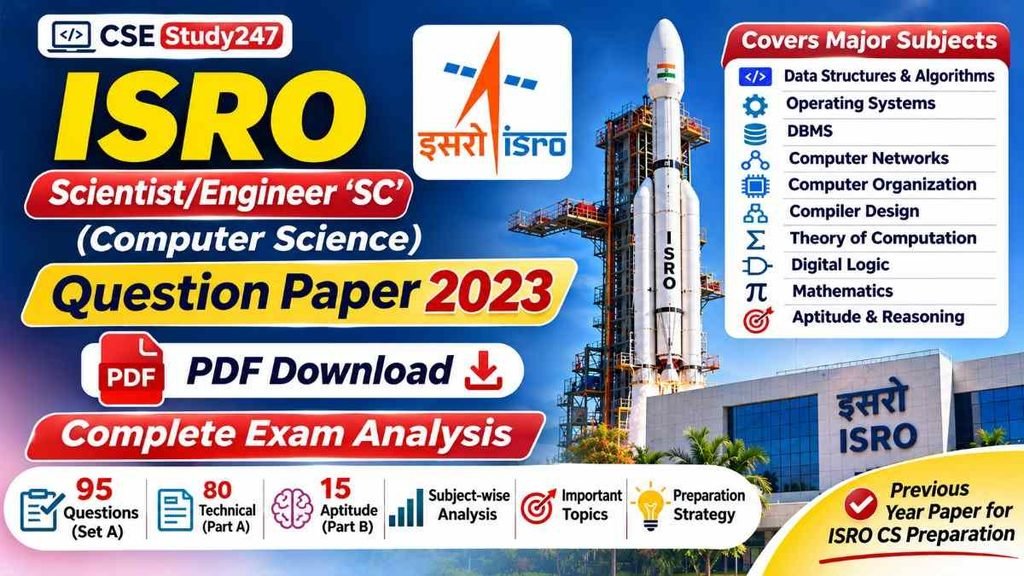
The 2023 question paper covers a wide range of Computer Science subjects, including Data Structures and Algorithms, Operating Systems, Computer Networks, Database Management Systems (DBMS), Computer Organization and Architecture, Digital Logic, Compiler Design, Theory of Computation, Mathematics and General Aptitude.
The examination tests both theoretical understanding and practical problem-solving abilities. Candidates will encounter algorithm-based questions, numerical problems, programming concepts, logical reasoning and analytical questions.
In this article, you can download the ISRO Scientist/Engineer SC Computer Science 2023 question paper PDF, explore its complete exam analysis, understand subject-wise coverage, identify important topics and follow a preparation strategy for upcoming ISRO examinations.
ISRO Scientist/Engineer SC Computer Science Question Paper 2023 – PDF Download
Candidates preparing for ISRO Scientist/Engineer SC recruitment can download and practise the 2023 previous year question paper.
The uploaded question paper is identified as Written Test for Recruitment to the Post of Scientist/Engineer ‘SC’ (Computer Science) – 2023, Set A.
ISRO Computer Science 2023 Exam Details
| Particulars | Details |
|---|---|
| Organisation | Indian Space Research Organisation (ISRO) |
| Examination | Scientist/Engineer ‘SC’ |
| Discipline | Computer Science |
| Examination Year | 2023 |
| Question Paper Set | Set A |
| Paper Language | English and Hindi |
| Question Format | Multiple Choice Questions |
| Part A | 80 Technical Questions |
| Part B | 15 Aptitude Questions |
| Total Questions | 95 |
| Available Resource | Previous Year Question Paper PDF |
ISRO Scientist/Engineer SC Computer Science 2023 Exam Analysis
The 2023 paper is divided into two major sections:
- Part A – Area/Discipline Specific: Computer Science technical questions.
- Part B – Aptitude/Ability Test: Reasoning, numerical aptitude and analytical questions.
The technical section contains 80 questions, while the aptitude section contains 15 questions.
Let’s understand the major subjects and concepts covered in the examination.
Part A: Computer Science Technical Subject Analysis
1. Data Structures and Algorithms
Data Structures and Algorithms form an important part of Computer Science preparation. The 2023 paper includes questions involving graph algorithms, tree operations, sorting techniques, complexity analysis and expression evaluation.
Important topics include:
- Minimum Spanning Tree (MST)
- Prim’s and Kruskal’s Algorithms
- Dijkstra’s Algorithm
- Floyd-Warshall Algorithm
- Bellman-Ford Algorithm
- Binary Search Tree
- Tree Traversals
- Inorder Predecessor
- Binary Tree Diameter
- Heap Sort
- Radix Sort
- Priority Queue
- Reverse Polish Notation
- Prefix Expression Evaluation
- Time and Space Complexity
- Asymptotic Analysis
- String Operations
- Graph Theory
Examples from the 2023 paper:
- Question 1: Finding the minimum spanning distance and corresponding number of edges in a graph.
- Question 2: Matching graph algorithms with their applications.
- Question 3: Finding the time complexity of calculating the diameter of a binary tree.
- Question 4: Finding postorder traversal from a given BST preorder traversal.
- Question 17: Converting an arithmetic expression into Reverse Polish Notation.
- Question 23: Evaluating a prefix expression.
- Question 24: Arranging functions in increasing order of asymptotic complexity.
- Question 25: Calculating comparisons for Radix Sort.
- Question 26: Finding the inorder predecessor in a Binary Search Tree.
- Question 29: Identifying the worst-case complexity of Heap Sort.
Preparation Focus: Give special attention to graph algorithms, tree traversal, sorting, expression conversion, priority queues and complexity analysis. Practise numerical problems involving graph construction and algorithm execution.
2. Operating Systems
Operating Systems is another important subject in the ISRO Computer Science examination.
The 2023 paper includes questions on memory management, process scheduling, multithreading, synchronization, interrupts and virtualisation.
Important topics include:
- Heap Memory Allocation
- Best Fit, First Fit and Next Fit
- Process Scheduling
- Long-Term Scheduler
- Medium-Term Scheduler
- Short-Term Scheduler
- Multithreading Models
- Linux Threading Model
- Priority Inheritance Protocol
- Semaphore
- Mutex Lock
- Producer-Consumer Problem
- Bounded Buffer Problem
- Memory Protection
- Segmentation
- Interrupt Handling
- Virtualisation
- Hypervisors
- Context Switching
- Page Faults
Examples from the 2023 paper:
- Question 9: Identifying the heap memory allocation strategy that exploits spatial locality.
- Question 48: Identifying the multithreading model followed by Linux.
- Question 49: Understanding the purpose of the Priority Inheritance Protocol.
- Question 50: Identifying the component responsible for assigning segment numbers.
- Question 51: Identifying an incorrect statement about interrupts.
- Question 52: Matching operating system process schedulers with their activities.
- Question 53: Selecting an appropriate synchronization primitive for the Producer-Consumer problem.
- Question 54: Understanding memory protection and invalid memory access.
- Questions 69–70: Virtualisation concepts and hypervisor techniques.
Preparation Focus: Focus on process scheduling, synchronization, semaphores, multithreading, memory management, segmentation and virtualisation. Understand the differences between various scheduling and synchronization mechanisms.
3. Computer Networks
Computer Networks is an important technical area covered in the 2023 question paper.
Questions test network performance, protocol overhead, wireless standards, error detection and TCP/IP concepts.
Important topics include:
- TCP Window Size
- Round Trip Time (RTT)
- Network Throughput
- Channel Utilisation
- CSMA/CD
- Minimum Frame Size
- Propagation Delay
- Transmission Delay
- Protocol Overhead
- Wireless LAN Standards
- IEEE 802.11
- Error Detection
- Error Correction
- CRC
- Parity Check
- Reed-Solomon Codes
- LDPC Codes
- Data Communication
Examples from the 2023 paper:
- Question 12: Calculating TCP window size to achieve a specified channel utilisation.
- Question 13: Calculating data transfer speed using CSMA/CD, frame size and propagation speed.
- Question 14: Calculating bandwidth wasted due to protocol headers in a five-layer network.
- Question 15: Matching IEEE 802.11 wireless standards with their speeds.
- Question 16: Identifying error-correcting codes.
- Question 22: Understanding techniques for detecting double-bit errors.
Preparation Focus: Practise TCP window calculations, bandwidth, throughput, transmission delay, propagation delay, network protocols and error detection techniques.
4. Database Management Systems (DBMS)
DBMS questions cover relational database concepts, SQL queries, database normalisation, transactions and relational operations.
Important topics include:
- SQL Queries
- Cross Join
- Natural Join
- Inner Join
- Nested SQL Queries
- DELETE Statements
- Aggregate Functions
- Database Transactions
- ACID Properties
- Durability
- Database Normalisation
- Fifth Normal Form (5NF)
- Join Dependency
- Relational Algebra
- Entity Relationship Model
Examples from the 2023 paper:
- Question 30: Evaluating the output of an SQL query after repeated database insertions.
- Question 31: Understanding the equivalence of SQL CROSS JOIN.
- Question 32: Identifying the correct SQL query for deleting records using a subquery.
- Question 33: Understanding the Durability property of database transactions.
- Question 34: Identifying the concept associated with Fifth Normal Form.
- Question 80: Understanding the Entity Relationship model.
Preparation Focus: Practise SQL queries, joins, nested queries, transaction properties and database normalisation. Pay special attention to query-based problems.
5. Digital Logic and Computer Organization
Digital Logic and Computer Organization test knowledge of logic gates, Boolean expressions, processor architecture, interrupts and digital circuits.
Important topics include:
- Multiplexer and Demultiplexer
- Encoder and Decoder
- Full Adder
- Logic Gates
- XOR, NAND, NOR and XNOR
- Boolean Algebra
- Truth Tables
- Shift Registers
- Micro-operations
- Instruction Pipelining
- Processor Architecture
- Interrupts
- Vectored Interrupts
- Cache and Memory Concepts
Examples from the 2023 paper:
- Question 18: Understanding vectored interrupts.
- Question 19: Identifying the processor architecture providing faster execution for a finite instruction set.
- Question 20: Understanding instruction pipeline implementation.
- Question 21: Identifying operations performed on data stored in registers.
- Question 35: Evaluating statements related to multiplexers, demultiplexers and encoders.
- Question 36: Calculating time delay through an 8-bit serial register.
- Question 37: Identifying the inputs and outputs of a full adder.
- Questions 38–40: Identifying logic operations and logic gate behaviour.
Preparation Focus: Practise truth tables, logic gates, Boolean simplification, adders, multiplexers, interrupts and processor architecture.
6. Theory of Computation and Compiler Design
Theory of Computation and Compiler Design are important theoretical subjects in Computer Science.
The 2023 paper contains questions related to finite automata, regular expressions, context-free grammars, parsing and compiler phases.
Important topics include:
- Finite Automata
- Deterministic Finite Automata (DFA)
- Nondeterministic Finite Automata (NFA)
- Epsilon Transitions
- Regular Expressions
- Context-Free Grammar
- Ambiguous Grammar
- Parse Trees
- Lexical Analysis
- Syntax Analysis
- Semantic Analysis
- Intermediate Code Generation
- Code Optimisation
- LL(1) Parsing
- Automata Minimisation
Examples from the 2023 paper:
- Question 7: Identifying the regular expression represented by an NFA with epsilon transitions.
- Question 8: Understanding ambiguity in a context-free grammar.
- Question 10: Identifying the correct order of compiler phases.
- Question 11: Understanding LL(1) parsing.
- Questions 55–56: Analysing DFA and NFA representations.
Preparation Focus: Study DFA, NFA, regular expressions, grammar ambiguity, parsing techniques and compiler phases. Practise converting automata into regular expressions and solving grammar-based problems.
7. Discrete Mathematics and Engineering Mathematics
Mathematics is also represented in the technical section.
Important topics include:
- Graph Theory
- Matrix Operations
- Determinants
- Probability
- Combinatorics
- Boolean Algebra
- Counting Principles
- Mathematical Expressions
- Complexity Analysis
- Permutations and Combinations
Examples from the 2023 paper:
- Question 41: Analysing the determinant of a given matrix.
- Question 42: Evaluating statements about graph properties.
- Question 43: Calculating the number of edges in a planar graph.
- Question 44: Probability-based problem.
- Question 45: Matrix multiplication complexity.
- Question 46: Calculating the number of substrings of a given string.
- Question 47: Determining the number of rows required in a truth table.
Preparation Focus: Revise graph theory, probability, matrices, determinants, combinatorics and mathematical fundamentals.
Part B: Aptitude and Ability Test Analysis
Apart from the technical Computer Science section, the question paper also contains an aptitude and ability test.
Part B starts from Question 81 and continues up to Question 95.
It includes logical reasoning, analytical ability, numerical aptitude, data interpretation and non-verbal reasoning.
Important Aptitude Topics
1. Logical Reasoning
- Logical Statements
- Statement and Conclusion
- Fact-Based Questions
- Course of Action
- Logical Deduction
2. Analytical Reasoning
- Seating Arrangement
- Circular Seating Arrangement
- Position-Based Problems
- Direction and Relationship Problems
- Arrangement-Based Questions
3. Non-Verbal Reasoning
- Figure Completion
- Missing Figure
- Pattern Recognition
- Figure-Based Reasoning
- Visual Analysis
4. Numerical Ability
- Number Series
- Wrong Number Identification
- Arithmetic Calculations
- Mensuration
- Percentage
- Maximum Area Problems
5. Data Interpretation
- Tables
- Graph Interpretation
- Percentage Increase
- Comparison of Numerical Data
- Earnings and Production Analysis
Examples from the 2023 paper:
- Questions 81–89: Figure-based, arrangement and analytical reasoning problems.
- Question 86: Circular seating arrangement involving eight people.
- Question 90: Fact-based logical reasoning.
- Question 91: Statement and course of action.
- Question 92: Finding the wrong number in a series.
- Question 93: Analysing a graph showing weekly earnings.
- Question 94: Calculating percentage increase using a production table.
- Question 95: Finding the maximum area of a rectangle with a given perimeter.
Preparation Focus: Practise reasoning, seating arrangements, number series, data interpretation, percentages and mensuration. Do not ignore aptitude while preparing for the technical section.
Most Important Topics for ISRO Scientist/Engineer SC Computer Science Preparation
Based on the subjects and concepts appearing in the 2023 paper, candidates should prioritise the following topics.
| Subject | Important Topics |
|---|---|
| Data Structures | BST, Trees, Heaps, Priority Queues |
| Algorithms | MST, Dijkstra, Floyd-Warshall, Sorting |
| Operating Systems | Scheduling, Semaphores, Threads, Virtualisation |
| Computer Networks | TCP, RTT, CSMA/CD, Error Detection |
| DBMS | SQL, Joins, ACID, Normalisation |
| Digital Logic | Gates, Adders, MUX, Boolean Algebra |
| Computer Architecture | Interrupts, Pipeline, Registers |
| Compiler Design | Compiler Phases, LL(1), Parsing |
| Theory of Computation | DFA, NFA, Regular Expressions |
| Mathematics | Graph Theory, Matrices, Probability |
| Aptitude | Reasoning, Series, Seating, Data Interpretation |
These are paper-derived preparation priorities, not a prediction of the exact weightage in future examinations.
What Makes the ISRO 2023 Computer Science Paper Important?
The 2023 paper demonstrates that candidates need a combination of theoretical knowledge and practical problem-solving skills.
The following question styles are particularly important:
1. Conceptual Questions
These test the understanding of fundamental Computer Science concepts.
Examples:
- What is the purpose of priority inheritance?
- What is the role of a compiler?
- What is a vectored interrupt?
- What is Fifth Normal Form?
2. Numerical Questions
These require the application of formulas and calculations.
Examples:
- TCP window size.
- Channel utilisation.
- Protocol overhead.
- Register time delay.
- Matrix multiplication complexity.
- Probability and graph theory.
3. Algorithm-Based Questions
These require candidates to understand the execution of algorithms.
Examples:
- Minimum Spanning Tree.
- BST traversal.
- Heap Sort.
- Graph shortest paths.
- Expression evaluation.
4. Diagram-Based Questions
These require interpreting diagrams and visual representations.
Examples:
- DFA and NFA diagrams.
- Logic circuits.
- Graphs.
- Aptitude figure patterns.
5. SQL and Database Questions
These test practical database understanding.
Examples:
- SQL JOIN.
- SQL DELETE.
- ACID properties.
- Database normalisation.
Preparation Strategy for ISRO Scientist/Engineer SC Computer Science
Candidates should follow a structured preparation plan to cover technical subjects and aptitude effectively.
Step 1: Complete Core Computer Science Subjects
Start with the major technical subjects:
- Data Structures and Algorithms
- Operating Systems
- DBMS
- Computer Networks
- Computer Organization and Architecture
- Digital Logic
- C and C++ Programming
- Theory of Computation
- Compiler Design
Step 2: Practise ISRO Previous Year Questions
Solve previous year papers to understand the examination pattern and question difficulty.
Practise questions from both technical and aptitude sections.
Step 3: Focus on Numerical Problems
Practise numerical problems regularly from:
- Computer Networks
- Operating Systems
- Algorithms
- Graph Theory
- Digital Logic
- Mathematics
Step 4: Prepare for Aptitude
Dedicate regular study time to:
- Logical Reasoning
- Number Series
- Seating Arrangements
- Data Interpretation
- Percentages
- Mensuration
Step 5: Attempt Subject-Wise Mock Tests
After completing each subject, attempt a practice test to evaluate your preparation.
Step 6: Attempt Full-Length Mock Tests
Practise complete examination-style tests under timed conditions. Analyse your mistakes and revise weak concepts.
Practise ISRO Computer Science MCQs and Mock Tests on CSE Study247
Preparing through previous year question papers is important, but regular subject-wise practice is equally useful.
CSE Study247 provides Computer Science practice resources for students preparing for ISRO, GATE, PSU and other technical recruitment examinations.
Explore practice questions from:
- Data Structures and Algorithms
- Operating Systems
- DBMS
- Computer Networks
- Computer Organization and Architecture
- Digital Logic
- C and C++ Programming
- Theory of Computation
- Compiler Design
- General Computer Science
[Explore Computer Science Practice Tests – https://csestudy247.com/practice-test/]
Practise regularly, analyse your performance and strengthen your understanding of important Computer Science concepts.
📥 ISRO Scientist/Engineer SC Computer Science Question Paper 2023 PDF Download
Download will be available in 30 seconds
Join For More Updates
| 1. Official Telegram | Click Here |
| 2. Download App | Click Here |
| 3. Follow for AI Jobs | Clikc Here |
| 4. CS/IT Job Alert | Click Here |
| 5. Join For Engineering Exam Job Alerts | Click Here |
| 6. DRDO & ISRO Job Alert | Click Here |
| 7. EXAM PYQ PDF | Click Here |
| 8. Placement CS\IT | Click Here |
Frequently Asked Questions (FAQs)
1. Where can I download the ISRO Scientist/Engineer SC Computer Science Question Paper 2023?
You can download the ISRO Scientist/Engineer SC Computer Science 2023 Set A question paper PDF using the download section provided in this article.
2. How many questions are included in the ISRO Computer Science 2023 paper?
The uploaded paper contains 95 numbered questions, including 80 technical questions in Part A and 15 aptitude questions in Part B.
3. Which subjects are covered in the ISRO Scientist/Engineer SC 2023 paper?
The paper covers Data Structures, Algorithms, Operating Systems, Computer Networks, DBMS, Digital Logic, Computer Organization, Compiler Design, Theory of Computation, Mathematics and Aptitude.
4. Does the ISRO 2023 Computer Science paper include aptitude questions?
Yes. Part B is titled Aptitude/Ability Test and contains Questions 81–95
5. How should I prepare for the ISRO Scientist/Engineer SC examination?
Focus on core Computer Science subjects, practise previous year questions, solve numerical problems, prepare for aptitude and regularly attempt mock tests.