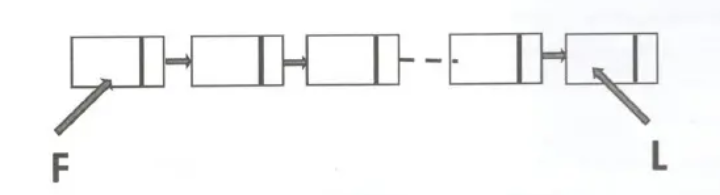
Correct Answer: (a) Delete the last element of the list
Explanation
• Why (a) depends on the length of the list: To delete the last element, the next pointer of the second-to-last node must be updated to NULL. Since a singly linked list only maintains forward links, you cannot step backward from the last pointer L. You must start from the first pointer F and traverse all \(n-1\) nodes to locate the second-to-last node. This takes linear time, \(O(n)\).
• Why the other options do not: Deleting the first element (b), appending an element using the tail pointer L (c), and swapping the first two nodes (d) all involve a fixed number of pointer manipulation operations that execute in constant time, \(O(1)\), independent of the list's total length.