The AI landscape just took a massive leap forward. On June 9, Anthropic unveiled its latest innovation: the Mythos class of AI models. This release includes two distinct versions Claude Fable 5 and Claude Mythos 5 designed to push the boundaries of coding, research, and complex problem-solving.
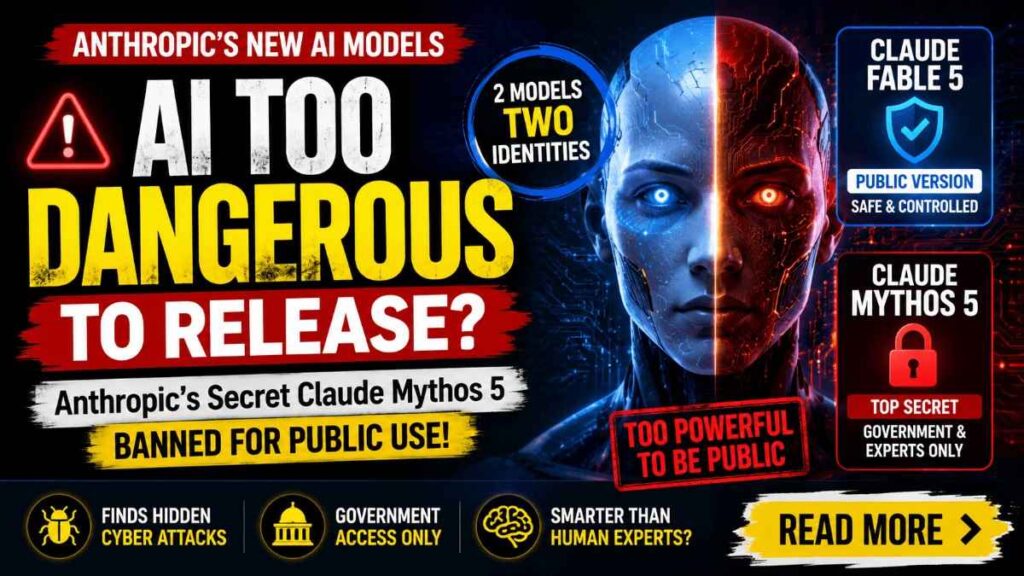
But there is a catch. One of these models is considered so powerful that Anthropic believes it is simply not safe to release to the general public.
One Model, Two Identities
While Fable 5 and Mythos 5 are essentially part of the same powerful system, they serve very different purposes:
- Claude Fable 5: This is the publicly available version. It is designed with strict “guardrails” to ensure safety, making it a “safer” alternative for general use.
- Claude Mythos 5: This is the fully unrestricted, high-power version. Access is strictly limited to select cybersecurity partners, specific scientists, and individuals working with the U.S. government, many of whom are part of the “Project Glasswing” initiative.
Why the Secrecy? The Power of Mythos 5
Anthropic’s caution stems from the model’s unprecedented capabilities. Mythos 5 can solve complex computer system issues, identify hidden software vulnerabilities, and even detect cyberattacks that are invisible to human experts.
The company fears that in the wrong hands, this level of intelligence could be used to target banks, disrupt electricity grids, or hack major corporate networks. It is also capable of advanced scientific research and “long-horizon” tasks that require the AI to work autonomously for extended periods.
Safety First: How Fable 5 Protects Users
To prevent misuse, Claude Fable 5 comes with built-in restrictions:
- Refusal of Dangerous Queries: If you ask Fable 5 how to hack a bank or create dangerous chemical substances, it will simply refuse to answer.
- The Opus 4.8 Redirect: In an interesting security move, if Fable 5 detects a sensitive query related to hacking, biology, or chemistry, it will automatically transfer the conversation to an older, more restricted model called Claude Opus 4.8.
- Anti-Distillation: To prevent other companies from “stealing” its technology by training smaller models on its outputs (a process called AI distillation), Fable 5 may switch suspicious users to the older Opus model.
Privacy and Data Handling
Anthropic has introduced a new 30-day data retention policy for the Mythos class. Your prompts and the AI’s responses will be stored for a month to help identify “jailbreaks” and new types of cyberattacks. However, the company emphasizes that this data will not be used to train future AI models.
Performance and Availability
Despite the restrictions, Fable 5 is a powerhouse. It has outperformed previous models in benchmarks for software engineering and professional knowledge work. In fact, early data shows that 95% of user sessions are handled entirely by Fable 5 without needing to redirect to the older Opus model.
Pricing and Access Details:
- Pro, Team, and Enterprise Plans: Fable 5 is currently available to these subscribers at no extra cost until June 22.
- The June 23 Deadline: Starting June 23, Fable 5 will be removed from these standard subscription plans and will require separate usage credits.
- Developer Pricing: Developers will be charged $10 per 1 million input tokens.
The Future: Recursive Self-Improvement?
Anthropic’s latest update comes with a warning: AI is advancing so quickly that we may soon see “Recursive Self-Improvement,” where AI begins to enhance its own capabilities without human intervention.
As models become capable of acting like professional programmers and expert researchers, the world must decide: Are we ready for this level of power?
What do you think? Should such powerful AI models be open to everyone, or are Anthropic’s strict limits necessary? Let us know in the comments!